An analogy crosses my mind, and that is the conquering of Americas. The story goes: there is this archetpye of an arrogant business man, all dressed up, proud and self-confident, coins mingling in his pocket (status). This man with an army of inferior others steps on a continent where he degrades all of the pre-existing culture for he finds it savage, uncivilized, unmonetized. This is what is still happening today and it is coming from the same hyerarchical positions that influence opinions and decisions which will keep the market stable. This won’t go on forever – either small man decides to live differently today, or we put an end to us by destroying the planet completely.
Voilá! Ladies and gents, Mr Stephen Wolfram:
The vast majority of this post will probably be application of Stephen Wolfram’s lecture on “How Features of Consciousness Seem to Define Our Laws of Physics and Mathematics” combined with the concept of qualia and physicalist idealism. Some of this stuff might help us understand quantum gravity from a different perspective and offer a practical way of looking at the “mystery” particle, graviton.
I’ve written about some this in my previous posts, which you can check out on the homepage.
Many of my latest thoughts on combining consciousness, qualia, and physics have been refined by Andrés Gomez Emilsson and his research. You can check the archive of fascinating bunch of posts here.
Before we get into it all, allow me to mention that I find academic conformism immature and embarassing feature of our society. Rather than exploring scientific endeavours in a free, creative, and playful manner (for example, not looking for everything inside of materialistic frames + thinking oh please don’t use the word energy body when speaking about mind, it’s simply embarrasing), academics are enjoying the reputation of leading intellectual body despite the fact that they’re often licking arses of governmetal and state funds. Let’s agree that such approach obviously won’t lead to any kind of truth, but rather contribute to convenience and stability of already existing belief system.
It’s not what Kant would call enlightenment.
Change does not and will not come as an order, it will come once we gradually decide to live differently independent from demands and expectations set by the system.
There are several simple yet groundbreaking solutions that could lead towards something more “truthful”, and they obviously have to detach from the idea of what anyone thinks “truth should be like”. We’d have to redefine the materialistic dogma in social and academic circles and redefine the way in which we look at the world around us. There are some people out there doing this and there will be mentions of them.
Following are the necessary conditions in order to continue thinking about gravitation as a natural language of attention:
a) We have to think outside of our subjective timeline.
From a relativistic point of view, we can say that everything has already happened. Benefitial information for us could be contained within the quantum gravity field which we experience as subjective experience – qualia. Valence of an experience could be viewed as a gravitational pull of attention.
b) Finite matter in our universe necessarily repeats.
Meaning all the possible physical combinations are inclined to happen again – somewhere far away, or if you prefer to look from temporal perspective, long time ago.
c) Res extensa and res cogitans are two intertwined physical substances.
d) Consciousness is electromagnetic and has vector properties.
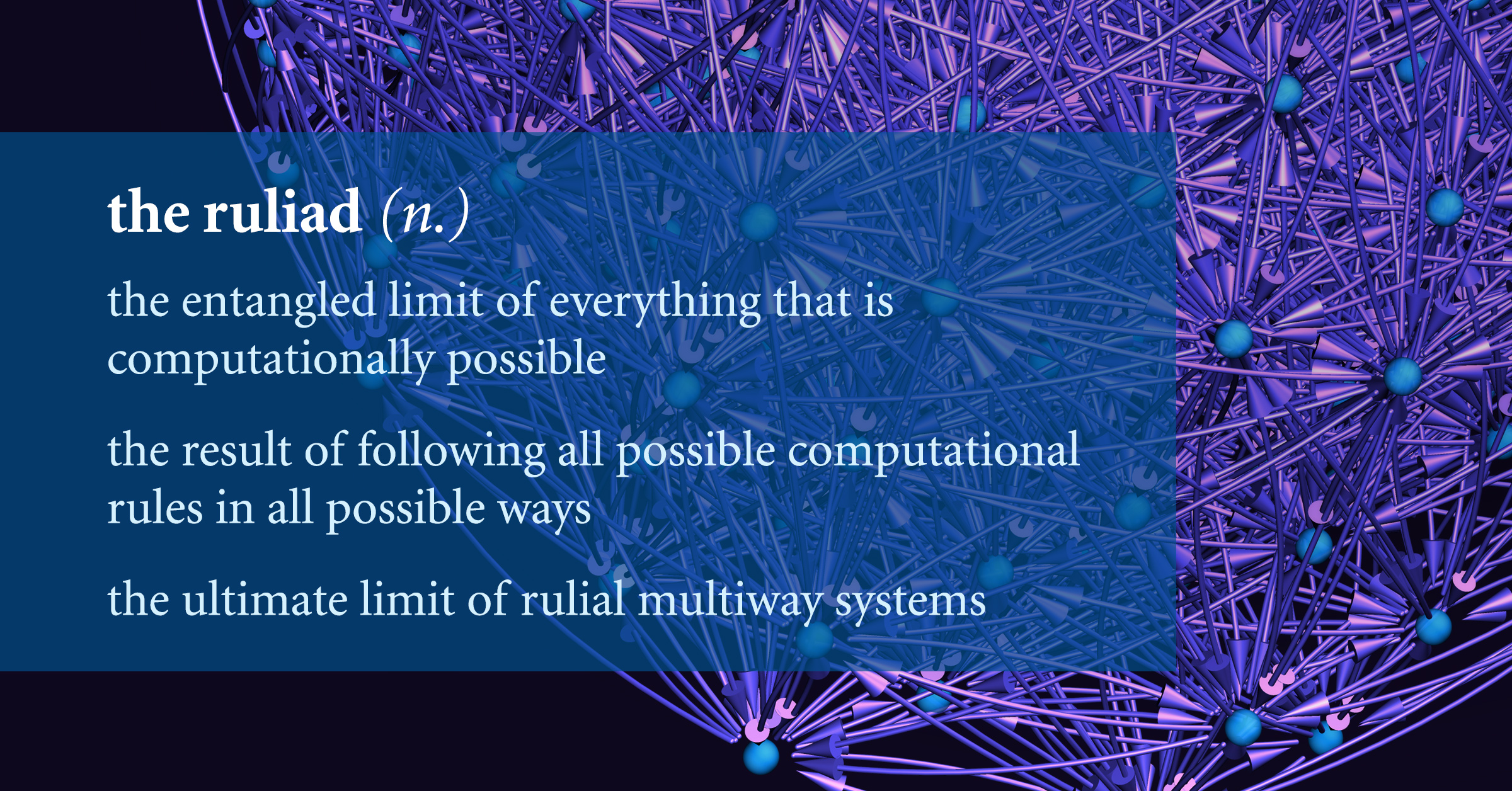
e) The ruliad is a mathematical abstraction of all possible rules/qualia.
I personally find d) + e) most interesting points for creative thinking. Here we could find ways for implementing the predicted mystery particle “graviton” as that tip of the vector which navigates the path of consciousness in the mental, branchial space. Besides that, graviton might also have a role in glueing subjective past and future states together within our conscious experience, depending on where we focus our attention. There’s an interesting follow-up on consciousness observed as a memory system.
Although many scientists strongly oppose it, consciousness can be described by physics. Qualia Research Institute is a nonprofit research institute dedicated to discovering the mathematical structure of conscious experience and cataloguing qualia. Here you can see the glossary.
Now let’s see what interesting news recent research has brought!
MIT: “Neurons are fickle. Electric fields are more reliable for information.“

We can view information as nature’s inherent knowledge acquired through countlessly many iterations of the material world (the more you do something, the better you get); ergo, the more iterations, the more “gravitational” weight on those rules/qualia.
From evolutionary perspective, gravitation towards rules/qualia that bring prosperity to a subject is an important feature. The question remains why are only certain memes “powerful” as much that they establish possessive dominance over their hosts (let’s say, for someone becoming a priest, shaman, artist, or a passionate activist). A system that works this way implies evolution of consciousness as a completely sensibile and legitimate part of natural selection which is rooted in laws of physics.
Look at how nice these qualia are entangled:
There are many other interesting papers contributing to this problem, and before continuing I will link a few:
Consciousness as a Memory System (Oct 3, 2022)
Consciousness binds elements of an experience together, allowing for the creation of a memory trace that can include multisensory details. Over time, consciousness provides a medium in which these memory traces can be replayed—a mechanism that is key to their successful storage.
The Easy Part of the Hard Problem: A Resonance Theory of Consciousness (Oct 31, 2019)
Synchronization, harmonization, vibrations, or simply resonance in its most general sense seems to have an integral relationship with consciousness itself. One of the possible “neural correlates of consciousness” in mammalian brains is a specific combination of gamma, beta and theta electrical synchrony. More broadly, we see similar kinds of resonance patterns in living and non-living structures of many types. What clues can resonance provide about the nature of consciousness more generally? This paper provides an overview of resonating structures in the fields of neuroscience, biology and physics and offers a possible solution to what we see as the “easy part” of the “Hard Problem” of consciousness, which is generally known as the “combination problem.” The combination problem asks: how do micro-conscious entities combine into a higher-level macro-consciousness? The proposed solution in the context of mammalian consciousness suggests that a shared resonance is what allows different parts of the brain to achieve a phase transition in the speed and bandwidth of information flows between the constituent parts.
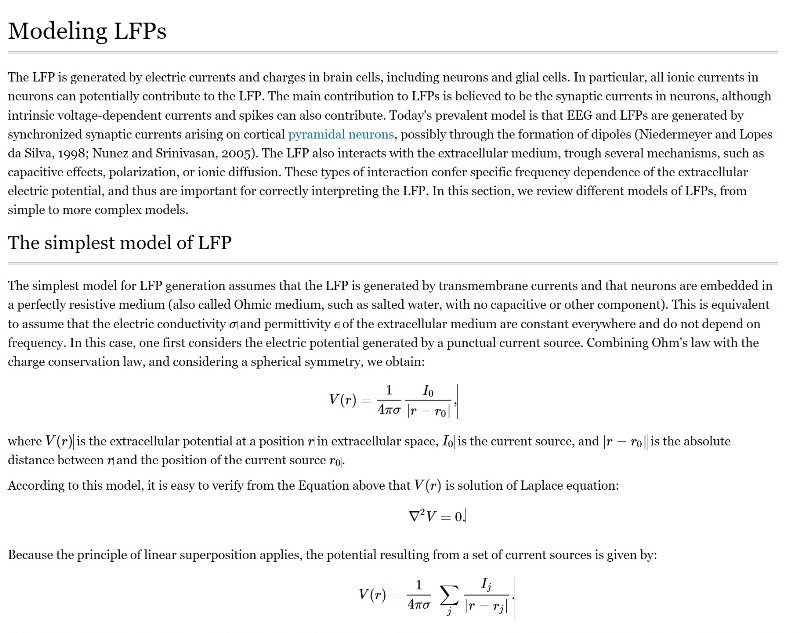
The origin of extracellular fields and currents — EEG, ECoG, LFP and spikes (May 18, 2012)
How does the electric field around brain work & Local Field Potential
- All currents in the brain superimpose to yield an ‘electric field’ at any given point in space.
- Extracellular currents arise from many sources, including synaptic currents, fast action potentials and their afterpotentials, calcium spikes and voltage-dependent intrinsic currents.
- The magnitude of extracellular currents depends critically on two factors: the cytoarchitectural organization of a network and the temporal synchrony of the various current sinks and sources.
- Depending on the recording method, neuroscientists distinguish between electroencephalogram (EEG), electrocorticogram (ECoG) and local field potential (LFP; also known as micro-, depth or intracranial EEG), although all of these measures refer to the same biophysical process.
- The electric field is the force ‘felt’ by an electric charge, and can be transmitted through brain volume. The extent of volume conduction depends on the relationships between the current dipole and the features of the conductive medium.
- The voltage gradients generated by highly synchronous activity of neuronal groups can affect the transmembrane potential of the member neurons and alter their excitability through ephaptic coupling.
- Synchronous spiking of nearby neurons is the main source of the high-frequency components of the local field.
- There is a discernable relationship between the temporal evolution of cell assemblies and the time-dependent changes of the spatially distributed currents. High-density, wide-band recordings of the local field can therefore provide access to both afferent inputs and the spiking output of neurons.
scholarpedia.org: LPF’s:
3 points: Can we make sense of quantum gravity through qualia, the ruliad, and the “mystery” graviton?
From the perspective that our subjective experiences and their valence stand behind selfish memes that are describable by physics (physicalist idealism), we still have to elaborate the question:
What would the benefit of consciousness be for having its own selfish evolution – what would have to be true about the world?
1. The ruliad – entangled limit of everything that is computationally possible.
As observers, we exist inside of physical and phenomenological timelines.
What pervades spacetime is gravity – a tendency of objects to attract or repel each other. This is the material space, res extensa. It exists within space-time.
What pervades mental space, res cogitans, is an abstract space of all qualia based on mathematical rules, isomorphic phenomenology entangled within the network which is the ruliad.
What if each nod within the ruliad holds subjective meaning encoded in gravitation?
Emilsson: “For any given qualia there is a mathematical object.” Find elaboration on non-materialistic physicalism right here.
What Wolfram has to say is, this mental world of ours is the world that we explore with functions of consciousness, and from that we derive our laws of mathematics and physics. The talk where he explains this is linked at the beginning of this post. Additionally, we can truly never know the material world directly, for information about it always has to pass through our biological sensory filters. Emotional valence is refined through memory, unless it is of direct survival importance.
2. Not only brain has cognitive functions. Cells demonstrate learning, predicting, and memory.
If we can agree on the logic that matter in time necessarily has to repeat itself, we could also agree that it had already happened countless times. In that context, consciousness as a memory system holds information about those events that are relevant for us as observers – it is also relativity.
This can naturally also be seen from quantum physics perspective as a superposition of all outcomes (quantum gravity spectrum of all qualia):
That what lead in the past towards best performances carries more “weight” and it is relative to the trajectory of a subjective experience of an observer.
The simplest way of doing that is through gravitational force for it doesn’t require an intelligent language.
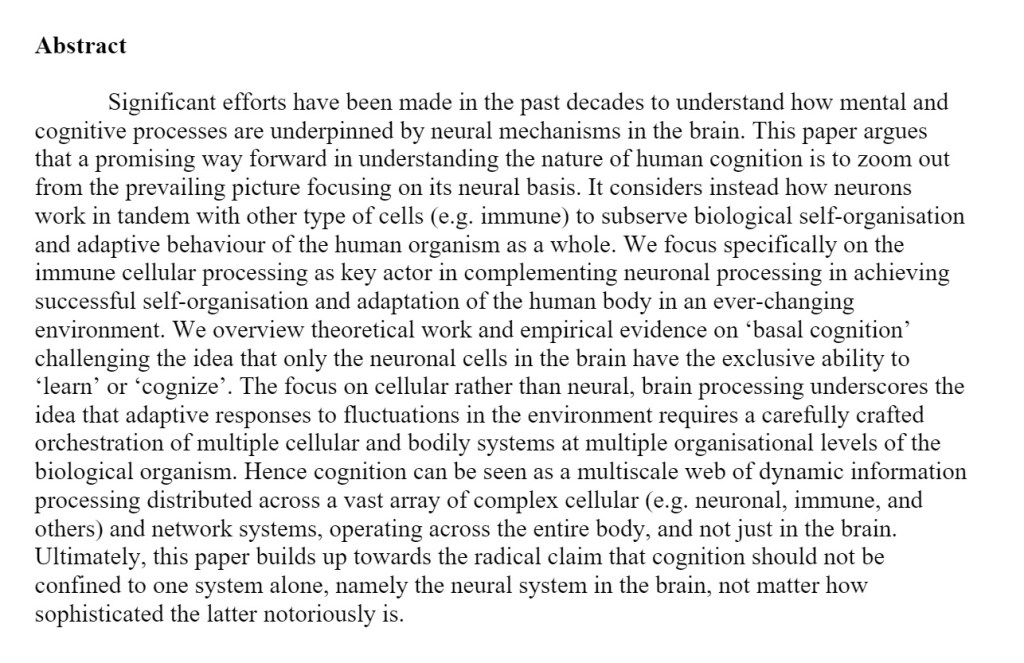
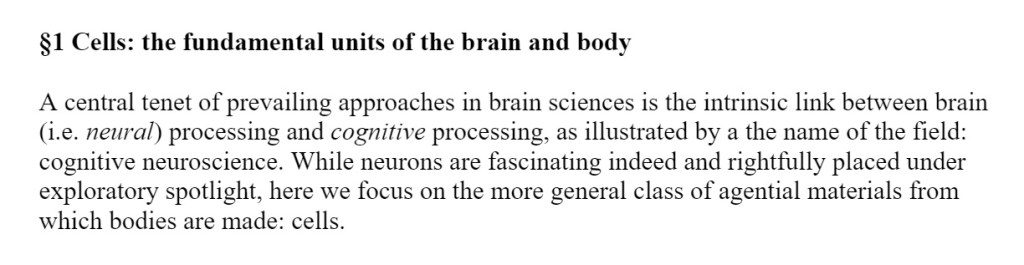
In the article preprint “The Brain is not Mental” it is described how cells learn and memorize biochemical combinations which have been found as the most successful from an evolutionary point of view. We can view cells as proto-neurons because they demonstrate proto-cognition. How do they do that if they don’t have a brain? This information has to be encoded somewhere.
Here are two short bits from the paper:
1)
2)
3. And finally: Gravitation as the natural language.
General, widely discussed problem with consciousness is language and its limitations. What if we eliminate that? A simple truth is that our understanding of the world is still growing and there is no way to be linguistically correct when *explaining* why we’ve made certain decisions or why do we feel as we do. Introspection can help here but it is a practice that the majority of people don’t do because they often don’t have time and sometimes educational background. Gravitation and gut-feelings can take care of this regardless of cognition. Only if we’d all learn how to recognize and take care of our emotional states, there would be less demand for taking it elsewhere.
Today we can prove that conscious cognition follows only *after* a decision has already been made by the brain: feelings precede thoughts. Access consciousness is a linguistic, explanatory delusion rooted in language that makes us believe that we control our actions. Therefore, we have to think beyond language that we know, and more universally. Maybe you already have a hunch:
What is the language that could be common to all beings that have existed and/or will exist independent of subjective timeline?
It seems that the answer to this should indeed be the gravitational force simply because it doesn’t depend on idiosyncratic communication system developed in between local inhabitants of the (local) universe.
Finally, if we take the Everettian quantum mechanics interpretation, the most popular one, it could therefore be possible that consciousness has access to all those universes, and that it happens no more or less but through imagination and the function of memory.
While doing internship in a psychiatric hospital, I was touched by schizophrenic patients and the observation that it seems how they have completely landed in an idealistic spectrum of perception of the world. Head in the clouds, catharsis gone wrong. Term such as “disorder of consciousness” could explain why they are experiencing qualia different to other population. Naturally, there is also a neurochemical basis to it. It just also becomes less bizarre to think about dreams – it’s the popping up of all those different outcomes within many-worlds. Cheerio to dopamine! Dream are only bizarre only once we look at them through our learned lense, our narrow conscious pespective of life that we are used to in this particular, one-version of the full story.
At the end, let’s end with some more science-fiction which is our reality.
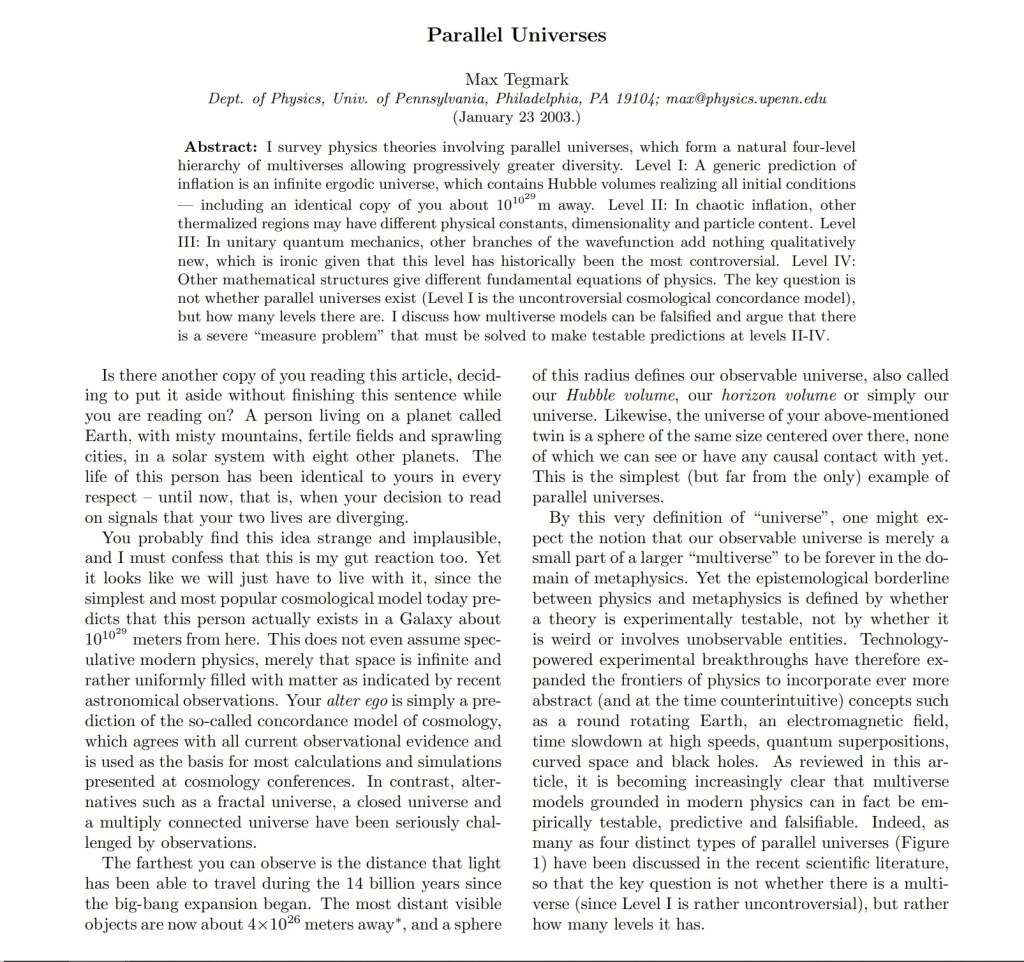
Max Tegmark:
The key question is not whether parallel universes exist, but how many levels there are.
Now I am asking you, what it is that pervades all those universes?
Extras:

Bayesian sinks and attention in The Hyperbolic Geometry of DMT Experiences: Symmetries, Sheets, and Saddled Scenes (qri.org).
Apart from writing for qualiacomputing.com, Andrés has an amazing channel focused on consciousness and qualia. Honestly, I recommend all of his work. There are high quality, detailed explanations of how one can mathematically describe experiences and their valence from perspective of lower and higher dimensions, but also amount of energy that is necessary to access specific mental states. For example, hypermeaningful states of consciousness can be described by symmetry in higher dimensions, which leads to scientific explanations of mystical experiences or even enlightenment. I find it pretty sweet and funny when Andrés laughs at himself while speaking about these topics, such as numerology for example, saying that he knows all of this can sound like mental illness (like hyperassociating numbers with meaning). I’ve obviosly had to do that disclaimer several times as well. It’s up to you to decide for yourself.
Justin Riddle on the other hand has PhD in psychology and is currently a postdoc in psychiatry who’s been teaching “Quantum Consciosness” at UC Berkeley and now he is bravely and kindly sharing his thoughts with the online world. His speculations are very much on the trace of what I’ve been thinking and writing about, but naturally way more detailed.
Respect for using the word “soul” here despite so much judgement and bias towards this!
Anyhow, it seems to me that this group of people gathered around empirical science of consciousness will open the gates for a revolution which will essentially start integrating consciousness in the domain of several natural sciences like physics, biology, neuroscience, and chemistry.
Also btw, Daniel Dennett never tried psychedelics?!
– – –
Check out other essays.

 Thoughts On Evolutions
Leave a reply to Why Music Theory of Consciousness? Investigation of Qualia Formalism at the Implementation Level – Things I Wasn't Supposed to Talk About Cancel reply