A quote that summarizes ontological shock:
THE INSIGHT THAT OUR UNDERSTANDING OF THE WORLD AS A REALITY INDEPENDENT OF MENTATION IS A MISTAKEN INTELLECTUAL INFERENCE
– Bernardo Kastrup, More Than Allegory
Greetings, curious reader!
You may roam through the blog and have a deeper look on why do I suggest dualistic evolution – one being the one of selfish gene (biological evolution of matter) and the other of selfish meme (cultural evolution transcending physical time). My brain has had its share of luck to be struck by a solid, organic electrical shock (unexpected boost of high energy) that updated my previous mental setup into something fundamentally different. I would describe it as an ontological shock.
The hypersane are among us, if only we are prepared to look – Big Think
In this post I merely wanted to point out the pretty obvious political interest for materialist theories. In this banned TEDx talk I’ve come across one of the most concise criticism I’ve ever heard, which naturally gives good reason for having it banned:
Within dualistic theoretical framework I find the propagation of meme to be backed up by functions of consciousness which is represented by a string/loop propagating through abstract system of all the possible rules – the Ruliad. I tend to explain this in details in many other essays on this blog with the final intention of publishing a book.
Due to strong influence by the dogma of materialism we are denying another side of this ontological coin which is physical coexistence of both immaterial and material. Property dualism describes this as both mental and material properties being result of the same physical substance.
Physical as in explained by the laws of physics. Just like consciousness. Just look at what people at QRI are doing.
Circles are immensely important. I swear, I fell in love with circles and I’m not even diagnosed with autism. Long story short…
Once one end of the string (having left and right side, or if you like, positive and negative side with electromagnetic properties) comes across its other end and binds to it, it naturally forms a circle. This is extremely important when speaking of symmetry and asymmetry, properties of crystals or extremely pleasurable emotional states which we tend to describe as mystical or religious ecstasy. As experience becomes more symmetrical, so does valence. This is beautifuly described as qualia formalism by QRI.
This has been a part of almost every ancient cosmology largely depicted by serpents. I tried to be brief and clear about this in my post “How Is Enlightenment Real?” where I offer some physical explanations that could explain phenomenology.
Hence the power of “finding oneself” and transcendence – the Greeks took upon an adequate maxim – know thyself. I dive into this deep in the post on Strings.
Needless to add how the complete classical world we perceive is formed on binary principles – left/right, 0/1, black/white etc. This is working only in materialist presentism that functions on one side of the coin. I claim this is the reason why several experiments in particle physics have failed to detect predicted particles – they don’t even get materialized on this side of the coin. They exist within our imagination, within the mind, just like our notions of past and future. Just like future has not yet been created, the past also doesn’t exist. All that exists is right “now”, everything else is imaginary, and the imaginary is also physical. Moving to the next point.
I was in positive shock (well, several times after this all started) when finding out that one of most well-known atheist philosophers of our times, Daniel Dennett, suggested that selfish meme theory would actually be the only sensible one when speaking of explaining the (so far) unexplainable “mystical phenomena”:
“As people who read books on evolutionary theory will know, mice sometimes exhibit bizarre behavior, fearlessly walking into the waiting jaws of cats. They do this because they have been infected by the parasite Toxoplasma gondii, which can only reproduce in a cat’s digestive tract; the mouse’s behavior is thus adaptive, not for the mouse, but rather for the parasite. Dennett uses this as his starting point when discussing the nature of religion. Maybe religions are like T. gondii: they are self-reproducing patterns of human behavior (“memes”), which take over their hosts and make them carry out acts whose main purpose is to further spread the meme. To Dennett, the religious martyr is like a mouse whose brain has been modified by T. gondii.
If you are yourself religious, the above may leave you feeling angry and disappointed with the author. This is perhaps not the best reaction, since Dennett (I think, anyway) is genuinely trying to understand the nature of religion without judging it. To him, the meme theory is the only one that makes scientific sense, and throughout the book he stresses that it in no way implies that religion-memes would necessarily harm their hosts. As he says, our bodies contain trillions of non-human cells, many of which are essential to our survival. Religions may be deadly parasites like T. gondii; but they could equally well be as vital to human well-being as our intestinal flora, without which we would be unable to digest our food. And although a Christian will probably be unhappy to hear Christianity called a mind-virus, she may be more willing to stick that label on Scientology or one of the Pacific cargo cults. As long as it isn’t a religion you feel any personal affinity with, it does rather seem to make sense; once you’re prepared to agree with that, you may reluctantly admit that the distaste and anger you feel when the reasoning is applied to your own religion could just be the meme defending itself. Evidently, an adaptation which discouraged believers from even considering arguments against their religion would be fitness-increasing.” (goodreads quote)
My assumptions on answering the question posed in title do not tend to lead towards any kind of a conspiracy theory, but rather offer a grounded and logical view on the state of system in which we live in. We are pretty aware how grotesque the world has grown to be, where human lives matter less than profit. Countries are pretty much equal to crude companies struggling for maintaining their hierarchical spot on the list and they need money for that.
Denying the other side of nature’s reality contributes to this by convincing people that by gaining and spending money they will find happiness.
If science was completely open about asking questions, allowing an organic growth of contemporary reseach instead of feeding the same ones that contribute to the system based on products and profit, then there should of course be no place for banning people from academic institutions because they asked questions.
I quote some of those cases on the bottom of the homepage of the blog.
Just remember Timothy Leary.
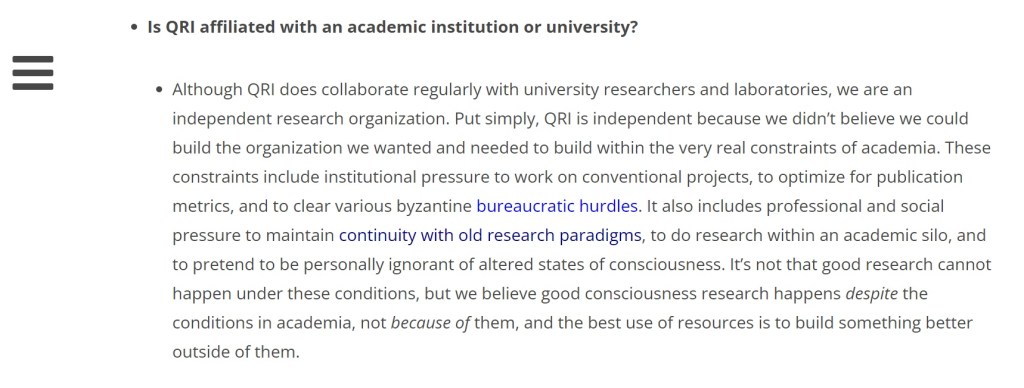
Or have a look at what Qualia Research Institute is working on! Research is not happening because of conditions in academia, but despite them.
If we presuppose that our reality is based merely on material grounds, it makes a lot more sense to fulfil our lives with physical goods that come with money, possession and having any kind of job. It’s benefit to the system and its oligarchy.
System: Don’t think, just work and bring money, our dear perfectly manipulated slave ❤
On the other hand, if a person who has achieved financial success finds themselves to still lead miserable life, contradiction and confusion kick in. Didn’t they do everything right?
Having a full-time job in a factory, store, or anywhere else makes people feel secure. I do not argue that there is something wrong about that. Sometimes jobs can be absolutely fulfilling and people do actually express their deepest desires and purposes by doing a particular job, and not just waiting for a paycheck, which in that first sense becomes merely an epiphenomenon of doing what you like. In that sense, I would also like to work as a psychotherapist, offer help to people who can’t afford it (which is also a systemic paradox – only if you are able to work = earn, you can pay to feel fine). On the other hand, understanding that wholeness, authentic happiness and satisfaction can only be achieved once our agency (being) in the world aligns with knowing thyself. That requires, of course, dedication and quite some time outside working hours.
If we were to talk about this publicly, the system would not be happy. That’s why you’d get banned like Rupert from the beginning of this post. Luckily, the internet will allow free thinkers to connect and create a separate branch of knowledge that will not have to be acknowledged by anyone getting paid by an institution that is controlled by higher governmental and/or private institutions with money.
Wouldn’t it be time to drop the zoo-ish competition, folks?
Time is the only real value we are bound to cherish. We have a long way learning how to do it.

 Thoughts On Evolutions
Leave a reply to Know thyself: Love, transcendence and solution to modern physics via /r/ancientgreece – THE WORLD OF SPACE Cancel reply