“What we consider to be normal human consciousness is in fact an altered states of knowledge: a delusionary condition of mental alienation and profound confusion that makes it very hard for us to see reality as it actually is. Some of us may experience fleeting moments of enlightenment when the mental fog is momentarily lifted and we see glimpses of the real; but ultimately the spell is much too powerful for any of us to to truly break it by ourselves. What we need is a revelation [apokalupsis].” (p.155)
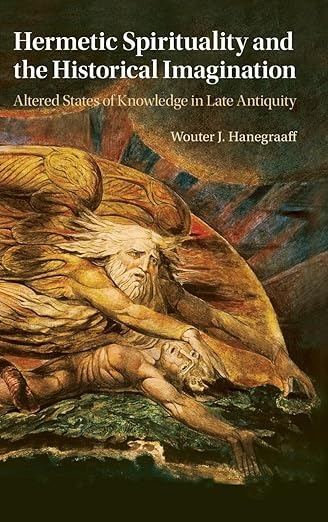
A brilliant introduction to the unspoiled meaning and intention behind what is commonly known as Hermetic philosophy is Wouter Hanegraaff’s Hermetic Spirituality and the Historical Imagination: Altered States of Knowledge in Late Antiquity. Calling what is actually spirituality a philosophy is like when we say we are “just into meditation” because we aren’t willing to deal with the discomfort that nonspiritual people around us might perceive our spirituality as a sign of weakness or fallacy of the illogical mind. This is a long and unfortunate story about how public discourse systematically morphed the word “spirituality” into something that implies pseudoscience and wishful thinking. The thing is: spirituality was never about thinking, but about feeling. A discovery of a quale.
As Hanegraaff repeatedly points out, consciousness-altering practices were aiming not for cognition but recognition in the most literal sense: when the gods make themselves known, the practitioners recognize them:“They realize that they have always known them but had just forgotten what they looked or felt like.” Innate gnōsis is knowledge by personal (re)acquaintance. This is Hermetic spirituality: religion of the cool kids that has more in common with ancient Egyptian magic than philosophy as an armchair speculation. This is like Mongols vs. Victorians.
Hermetic values, rooted in the ability to perceive Heaven on Earth, are replaced with an ideology that teaches that true values are in the façade, rather than in the interior of the house that cannot be seen from the outside and thus cannot be admired (not an appealing path for those dependant on external validation). However, Hermes might teach that the interior can be seen from the outside in some sense, but only by the observer, as it will be the glow of her nous perceived through her eyes, and not through the eyes of others whose “souls are at the room temperature.” The Hermetic heart is on fire: this is intrapsychic and somatic, not easily assessed through language-based psychological questionnaires.
In line with Western European post-Enlightenment “sophistication” relying on reason and thought rather than the “uncivilized” or “savage rituals,” direct access to altered states has gradually become marginalized, and later, in many forms, criminalized. Classical psychedelics aren’t illegal because they are harmful to one’s health; they are illegal because they make you pay attention to Nature and Beauty, not monetization. Hermetic practices make us value transcendence and self-discovery more than buying a new car, and the system fights against the transcendence of suffering because it perceives the situation as a virus aiming to take over the operating system. In fact, it is, and the immune reaction is natural.
Genuine spirituality isn’t about faith in immortality or that true happiness is possible If You Believe; it is allowing one’s consciousness to demonstrate its hidden potential and gain experiences beyond “classical biographies” (not the mechanical trajectory of feet but phenomenal trajectory of consciousness) that are often perceived as beneficial for wellbeing and general health because the emotions stop being as negatively valenced as they used to be. They are unitive and transpersonal experiences, ultimately private.
When talking about spirituality and mysticism, the point with consciousness here is the following: we can cook an egg only in boiling water and not in water that is at room temperature. It is still the same substrate – water, but depending on its temperature, the results or the outputs of consciousness are different. When all see the same world with our eyes, but it feels different. This is what is known as the knowledge of the heart. And this, I believe, is the essence of what “religion” promises to be, but, in contrast to spiritual practice, “religion” kisses us through the glass, and we don’t actually get to feel the pressure and warmth of the lips. The way in which the contract of a “passive believer” seems to work is devoting himself to kissing the glass behind which the lips of the Beloved may or may not be, and we will feel the kiss of its lips once we die – if we were good according to different sets of standards. The glass between lovers will break and the veil will be lifted. This will be Heaven.
Regrettably, instead of direct spiritual experience that, of course, often requires discipline, practice, and time, we are offered a variety of religions like different brands on a shelf, each preaching its own truth about salvation, leaving us with the choice of believing in one of them or deciding that none of them make sense. (And of course they don’t; they weren’t intended to be logical systems passed on as dead mythologies.) This is when many “academic intellectuals” conclude only atheism makes actual sense, but this is a categorical fallacy that, in my view, also lies behind the majority of chronic mood disorders. We are devoid of a somatic dimension of experience whose warmth comes through intimacy with the mind (not only including its fears and insecurities, but especially them).
Hanegraaff’s book points in the right direction by showing that original Hermetic spirituality wasn’t about the linguistic sophistication of philosophal practice; it was applied consciousness research that I spoke of in the previous post on rethinking the epistemology of archeology (if not the actual “science” of consciousness): training aimed at gnōsis, visionary transformation, research into intimacy with self and others that has absolutely nothing to do with whose God said what.
Everyone agrees: giving birth in beauty is what the Creator should be doing. And that Creator is us. How do we make ourselves more aware of the role of constructivism in our shared reality is the key pragmatic question. This may be healing the collective wound. Everything else is politics.
 Thoughts On Evolutions
Leave a comment