In September, I wrote an 8,000-word essay for a contest organized by Philip Goff and Andrei Berkoff “Is Consciousness Fundamental?”. The text is about the need to update our dominant paradigm, and it tends to bridge the gaps between science and spirituality by introducing qualia fields into fundamental physics. As it got rejected, I decided to publish it here.
This essay is an updated version of a text I’ve shared with Hatem Elshatlawy of the Wolfram Research Institute upon his inquiry in September 2023.
Contact: Twitter, LinkedIn, grobenskibeata@gmail.com
Citation: Grobenski, B. (2023) Why Music Theory of Consciousness? Investigation of Qualia Formalism at the Implementation Level. Blog: Things I Wasn’t Supposed to Talk About.

Abstract
This essay argues that rather than being a mere by-product of brain activity, consciousness plays an active role in shaping our reality. Our perception of the world is not a direct mirror of external reality but rather a construct of our minds. The colours, sounds, and sensations we experience are our brain’s interpretation of external stimuli. When we consider the mind-body problem, it’s tempting to fall into the dichotomies of materialism or idealism. There’s a middle ground: dual aspect monism. Here, I don’t posit two separate substances or reduce the mind to the brain. Instead, I suggest that both mind and matter are two facets of a singular, underlying reality, revealing themselves to us through sound and shape, namely, through cymatics. While challenging our conventional paradigms, the Music Theory of Consciousness offers a fresh lens through which we can interpret phenomena. Might our hedonic states, from the most blissful to the most agonizing, be intricately linked to the very fabric of the universe? Lastly, I examine how Wolfram’s computational and mathematical theories might offer us a missing piece for Qualia Formalism.
Content
Part 1: Dual aspect monism
1.1 Emerging assumptions
1.2 Problems with neurocentrism
1.3 Finding evidence in math
Part 2: List of topics and predictions to be addressed
Part 3: Conclusion
References
Part 1: Dual aspect monism
Solving consciousness is finding a mapping between the physical and phenomenological projections of reality.
Michael Johnson
Who said theoretical physics is just applied philosophy?
No, seriously. A fact that a scientist such as Stephen Wolfram turned from studying thermodynamics to “an observer theory” should tell us something important.
There is an interesting overlap between problems encountered in both neuroscience and physics that are relevant for this ontological discussion. I will mention and try to present some of them from a non-materialist perspective (such as the one built at the Qualia Research Institute where I’m working on “The Good Annealing Manual” project) and refer to Dr. Wolfram’s currently developing theories of ‘the ruliad’ (the entangled limit of everything that is computationally possible, i.e., the result of following all possible computational rules in all possible ways) and ‘the observer’.
Before we continue, it is important to have at least a brief overview of why and how a different ontological framework might be necessary to escape a dead-end street, such as the hard problem of consciousness, or the lack of an empirical framework that would manage to adequately describe the nature and quality of subjective experiences. As the title of this essay implies, we will be examining the possibility that music, harmony and symmetry might serve us as lenses that could answer some of the most stubborn problems of science today. All we need to do is to alter our perspective.
Cognitive scientist Steven Lehar, a proponent of Harmonic Resonance (1999), a theory that will be mentioned across this paper, pointed out howneuroscience and physics with their current ontological assumptions are in a state of serious crises.[1] Although both sciences have been digging deeper and deeper the fabric of the brain and physical world, the fundamental questions have still not been answered. There cannot be real progress because there is no universal consensus on how the brain actually codes information, Steven concludes and backs it up with John Searle’s famous quote referring to the same problem as “the dirty secret of contemporary neuroscience”[2].
Some academics are actively but carefully addressing the outdated paradigm by integrating research conducted at the frontiers of several scientific disciplines, such as for example cellular biology, computational neuroscience, or fundamental physics. I will refer to some of the work that addresses matters of perception more directly, a topic for which Stephen Wolfram developed greater interest after starting to think more deeply about a theory of an observer.[3]
A primary challenge we face today is that our interpretation of evidence is contingent upon paradigmatic assumptions. These assumptions have led to an increasing fragmentation into various theories of consciousness. This is a good sign that something has to change, and it’s a good sign that that something might be connected to our socially indoctrinated assumptions about the nature of reality, a topic addressed in a sincere and straightforward 2013 TED-talk[4] by Rupert Sheldrake banned quickly after. All panpsychists, idealists, dualists, or rather non-materialists, know very well that there is a great deal of resistance toward questioning fundamental ontological assumptions navigating the direction not only of science, but also society. It’s only a matter of time when there will be enough puzzle-pieces at disposal of everyone involved in order to recognize not just the need, but also direction for a paradigmatic change.
As famous philosopher of science Thomas Kuhn set the standard,this universal disagreement places neuroscience in the pre-paradigmatic state. However, there has been interesting development across several disciplines I’d like to address. As this is a philosophical text, I hope that the reader won’t mind creative interventions, as none of them should be considered factual.
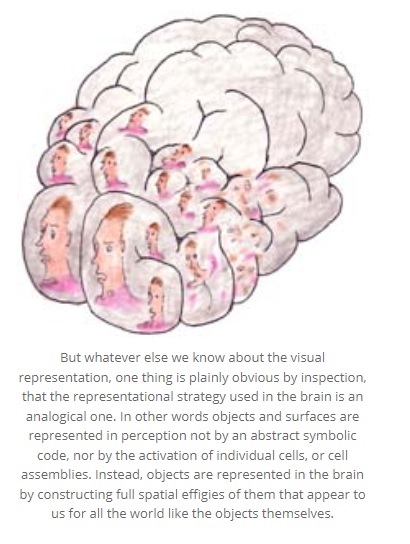
Steven Lehar’s ‘bubble worlds’. Source: https://qri.org/blog/steven-lehar-lineage
Before I introduce some of the core ideas that hope to offer a way out of the dead-end street we’re in, we have to make sure to take several fresh ontological assumptions seriously. In concordance with the realization that the dominant reductionist materialist doctrine won’t take us any further with building a theory of classical space-time as perceived by an observer, we need to get rid of its assumption that external objects exist without being dependent on the mind.
I wonder, what are the chances that this simple yet grand misconception lays behind decades of struggle with unresolved problems[5] in physics such as quantum gravity? I’ll speculate on this later in the text.
In order not to continue explaining phenomena from a misleading ontological viewpoint, in this model we have to agree on recruiting non-popular, but rather important philosophical positions. That is the one of non-materialist physicalism (wonderfully elaborated by David Pearce[6]) conjoined with the dual aspect monism (Gómez-Emilsson, Johnson).
Carrying a panpsychist sentiment, these two lenses should help us think somewhat more correctly about the if and the how of whether Wolfram’s ruliad could be physically implemented into the fabric of the universe. Or in his language, how is the ruliad perceived as it is by a computationally bounded observer like us?
In one of his interviews[7], Pearce explains his position:
Non-materialist physicalism is sometimes called constitutive panpsychism – though the term misleads. Panpsychism” evokes property dualism. Non-materialist physicalism is monist – it’s a conjecture of the intrinsic nature of the physical, the mysterious “fire” in the equations of quantum field theory. Only the physical is real; but the essence of a quantum field differs from our materialist intuitions.
If the intrinsic nature argument is sound, experience discloses the essence of the world’s fundamental quantum fields. Phenomenal binding into virtual world-simulations, not subjectivity per se, makes Darwinian animal minds special. Our common-sense belief in a material world stems from (1) an obsolete they of classical physics (2) a misunderstanding of the measurement problem in quantum mechanics and (3) a pre-scientific theory of perception.
As Wolfram mentioned in one of his most recent talks[8]:
We still need to figure out why observers like us are like us, why we perceive physics as we do, and what will this tell us about the way that time (the rate of change) works as it does.
Answers to these questions necessitate a robust theory of consciousness — a theory that will stick; a theory that will unify all the other theories; something we’ve intuitively known all along.
Excerpts from his essays ‘What is Consciousness?’ and ‘Finally We May Have a Path to the Fundamental Theory of Physics… and It’s Beautiful’ illustrate a pivotal shift in his perspective on consciousness:
I’ve always implicitly assumed that consciousness is just a continuation of the same story: something that, if thought about in enough generality, is just a feature of computational sophistication, and therefore quite ubiquitous. But from our Physics Project—and particularly from thinking about its implications for the foundations of quantum mechanics—I’ve begun to realize that at its core consciousness is actually something rather different. Yes, its implementation involves computational sophistication. But its essence is not so much about what can happen as about having ways to integrate what’s happening to make it somehow coherent and to allow what we might see as “definite thoughts” to be formed about it.
I have to say that although it’s a widespread concept in current physics, I’d never thought of energy as something fundamental. I’d just thought of it as an attribute that things (atoms, photons, whatever) can have. I never really thought of it as something that one could identify abstractly in the very structure of the universe.
So it came as a big surprise when we recently realized that actually in our model, there is something we can point to, and say “that’s energy!”, independent of what it’s the energy of. The technical statement is: energy corresponds to the flux of causal edges through spacelike hypersurfaces. And, by the way, momentum corresponds to the flux of causal edges through timelike hypersurfaces.
Each causal edge represents a causal connection between events, that is in a sense “carried” by some element in the underlying hypergraph (the “spatial hypergraph”). So a “flux of causal edges” is in effect the communication of activity (i.e. events), either in time (i.e. through spacelike hypersurfaces) or in space (i.e. through timelike hypersurfaces). And at least in some approximation we can then say that energy is associated with activity in the hypergraphthat propagates information through time, while momentum is associated with activity that propagates information in space.
Although one should be more familiar with Wolfram’s work in order to grasp his way of thinking, I believe there is a direction in which we can conceive of this energy behind activity in the hypergraph by integrating several interesting theories. We should start with having a look at Principia Qualia[9], a 2017 blueprint for building a new science of qualia. In order to continue, we need to make sure to take the following concepts seriously:
- Valence realism
- Valence structuralism
- Qualia formalism
- Qualia structuralism
If we don’t, assuming that qualia are 1) formalizable, and 2) a part of the physical reality determining the way we describe it won’t make sense, as it will be perceived as standing on false ontological assumptions, and therefore impossible. On the other hand, if we take these assumptions seriously, we might come to the conclusion that qualia relate precisely to that what Wolfram calls “imagining ourselves to have a certain definite persistence in time”.[10] And that’s a belief that makes our lives liveable.
But what binds it all together?
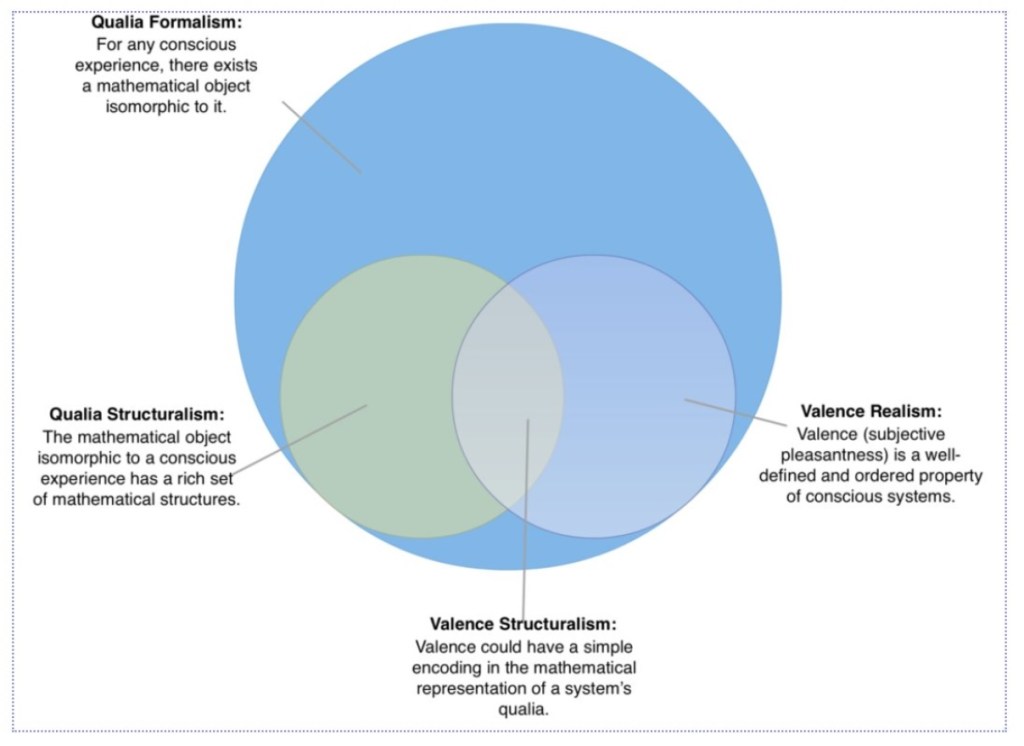
Principia Qualia (2017)
Other pivotal frameworks exist, such as the Symmetry Theory of Valence. This theory posits that the symmetry of a mind’s information geometry correlates with the pleasantness of the experience. As I won’t be addressing this deeper in this text, I would point the reader to the website of Qualia Research Institute and the work by Michael Edward Johnson.
[1] Lehar, S. 1999. Harmonic Resonance Theory: An Alternative to the “Neuron Doctrine” Paradigm of Neurocomputation to Address Gestalt properties of perception. http://slehar.com/wwwRel/webstuff/hr1/hr1.html
[2] Searle J. R. 1997. The Mystery of Consciousness. New York: New York Review.
[3] Wolfram, S. 2021. What Is Consciousness? Some New Perspectives from Our Physics Project. https://writings.stephenwolfram.com/2021/03/what-is-consciousness-some-new-perspectives-from-our-physics-project/
[4] Sheldrake, R. 2013. The Science Delusion BANNED TED TALK. https://www.youtube.com/watch?v=JKHUaNAxsTg
[5] Wikipedia. List of unresolved problems in physics. https://en.wikipedia.org/wiki/List_of_unsolved_problems_in_physics
[6] Pearce, D. 2014. Non-materialist physicalism. www.physicalism.com
[7] What’s it like to be a philosopher? http://www.whatisitliketobeaphilosopher.com/david-pearce
[8] YouTube. Mystery of Entropy Finally SOLVED after 50 years. https://www.youtube.com/watch?v=dkpDjd2nHgo
[9] Johnson, M. 2017. Principia Qualia. https://opentheory.net/PrincipiaQualia.pdf
[10] Wolfram, S. 2021. The Concept of the Ruliad. https://writings.stephenwolfram.com/2021/11/the-concept-of-the-ruliad/
1.1. Emerging Assumptions
As Andrés Gómez-Emilsson, QRI’s Director of Research, often points out, research on altered states of consciousness—whether induced by psychedelics or advanced meditation—echoes historical scenarios: observing consciousness in a normal waking state is comparable to studying matter only on room temperature and is therefore missing out on the significant implications of its characteristics.
Insights across several disciplines exhibit a common thread. Some of them are:
electromagnetism (engrams, memory), thermodynamics (entropic brain[1]), field topology (the boundary problem[2]), bioelectricity (endogenous voltage potentials controlling cell behaviour and instructing pattern regulation), nonlinear wave computing (within the context of string theory and the holographic principle, field dynamics), computational psychiatry (Bayesian brain and Free Energy Principle), complex dynamic systems, mathematics, symmetry, and consciousness studies.
Many of these ideas have been condensed into a theory of psychedelic thermodynamics.
Psychedelic thermodynamics refers to mapping how energy transforms and dissipates during psychedelic experiences. It involves modelling states of consciousness using concepts from thermodynamics like energy sources, sinks, equilibrium, and transformations. The goal is to formally describe the “energetics” of psychedelic experiences – how the high energy of psychedelics transforms into complex geometric patterns, sensations, emotions etc.Key aspects include modelling attention as an energy source, semantic recognition as an energy sink, symmetries and resonances as efficient ways to dissipate energy, and describing the overall “psychedelic process” as a thermodynamic transformation that can be quantitatively analysed.
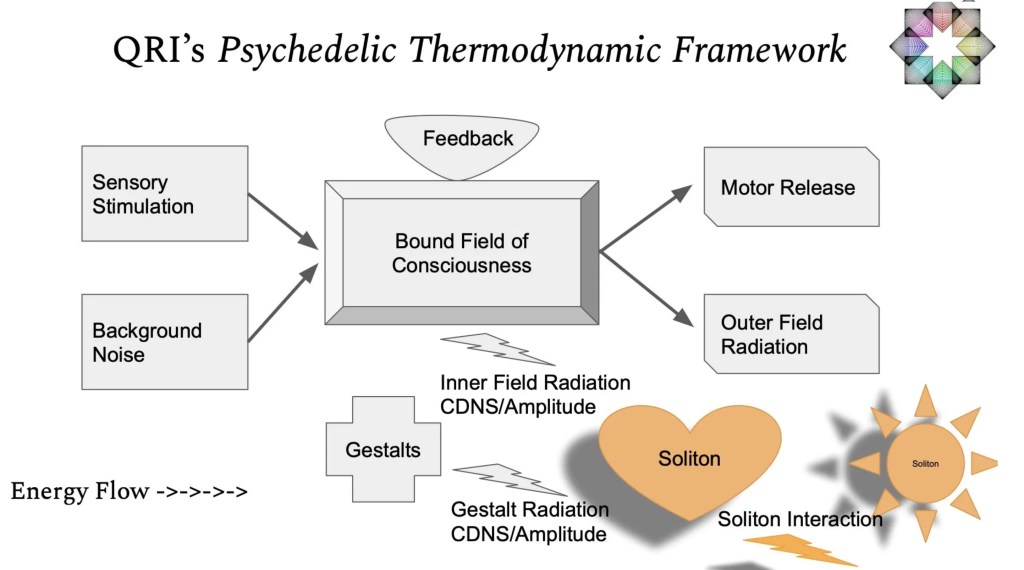
Image from Gómez-Emilsson’s blog Qualia Computing.
Source: https://qualiacomputing.com/2023/02/25/good-vibe-theory/
A question that has been bothering Wolfram, on the other hand, is why we have to run each step of the computation in order to know the future. Why can’t we foresee the future or predict it by bypassing certain steps? I believe this is where our agency and the causal influence of the mind come into play. Given our memory—or in Wolfram’s words—our belief that we are persistent in time, is ‘alive’(since we both observe and engage in a self-generating system as both observers and active participants), predicting the future would require executing each computational step, likely based on at least two foundational premises:
1) quantum agents like us constantly effect each other,
2) we have agency in the full meaning of that word (cybernetic term carrying teleological assumptions).
As Bobby Azarian pointed out in several talks[3] held at the Active Inference Institute, as well as in his 2022 book The Romance of Reality:
Precisely by extracting free energy, we resist entropic decay. Extracting free energy to self-organize is what keeps us alive, and a system that can exercise control is known as a cybernetic system. This is naturalization of teleology.
Can we take these ideas further all the way to the implementation level? As said at the beginning, with a good theory of consciousness, we should have a tool to solve several problems at once. An overlap between Qualia Formalism and the ruliad is yet to be studied and explored. Here are some initial ideas.
Let’s take an image of the ruliad. If there are bonds between rules, could there also be literal physical threads between qualia on the implementation level of consciousness?
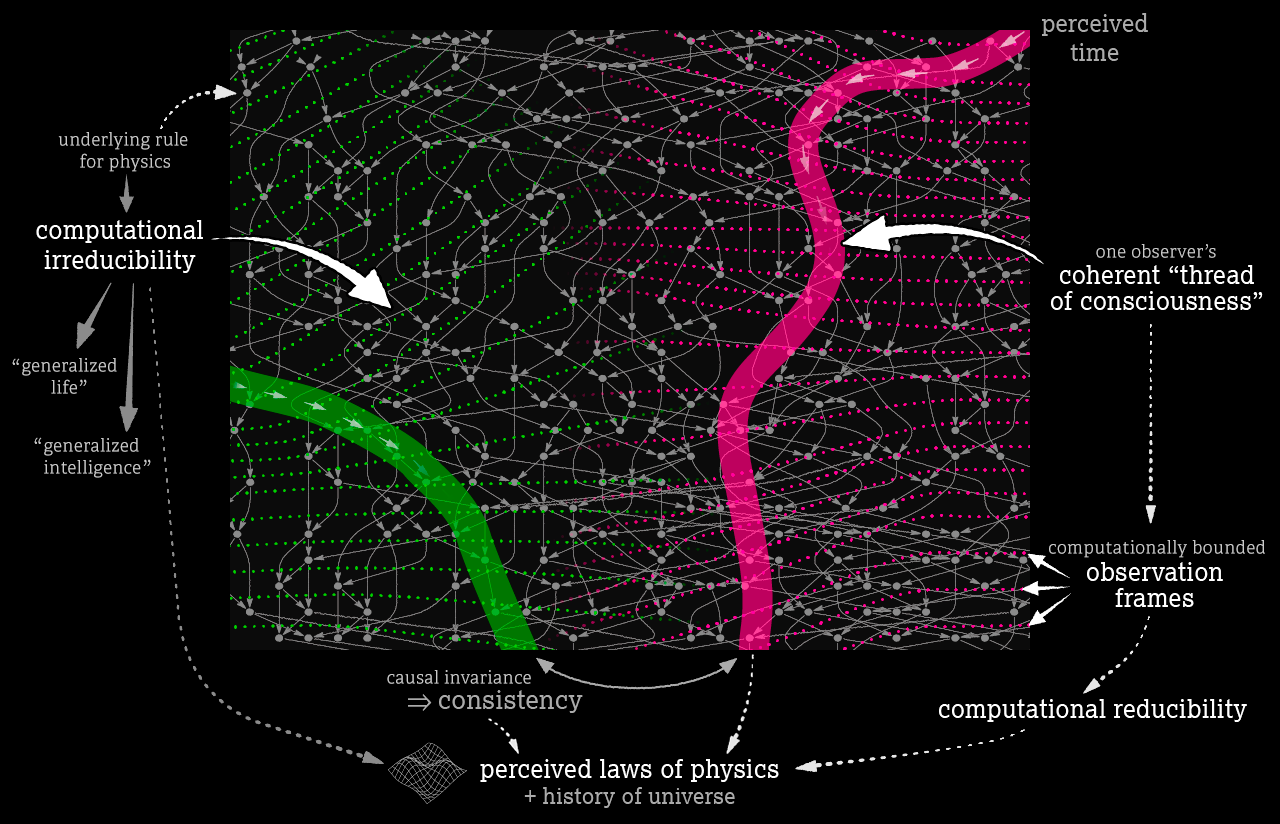
Wolfram explores the nature of consciousness in What is Consciousness?
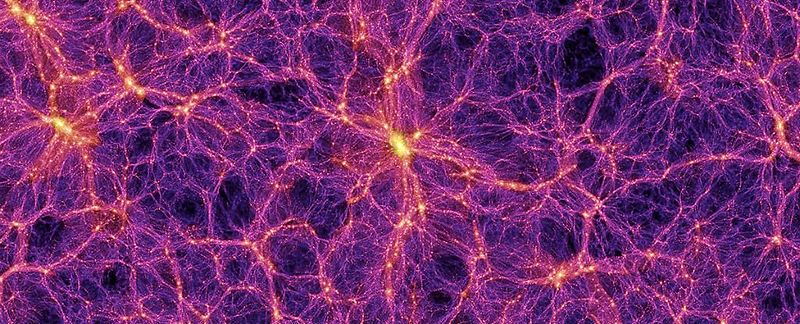
A living memory: “Rather than being a dictionary of possible separate universes, the ruliad is something that entangles together all possible universes.” Based on its energy landscape, a system with agency will search for configurations representing energy minima.
If the non-materialist physicalist view is true, then there are not only representational rulial threads connecting our past trajectories. Physically speaking, adding to Wolfram’s realization about fundamental energy, qualia should be defined by nothing else than a vibration, i.e. fundamental energy, which, under the necessity between sound and shape, as demonstrated by Chladni plates[4], results with at least one important conclusion. The cosmic symphony is real!
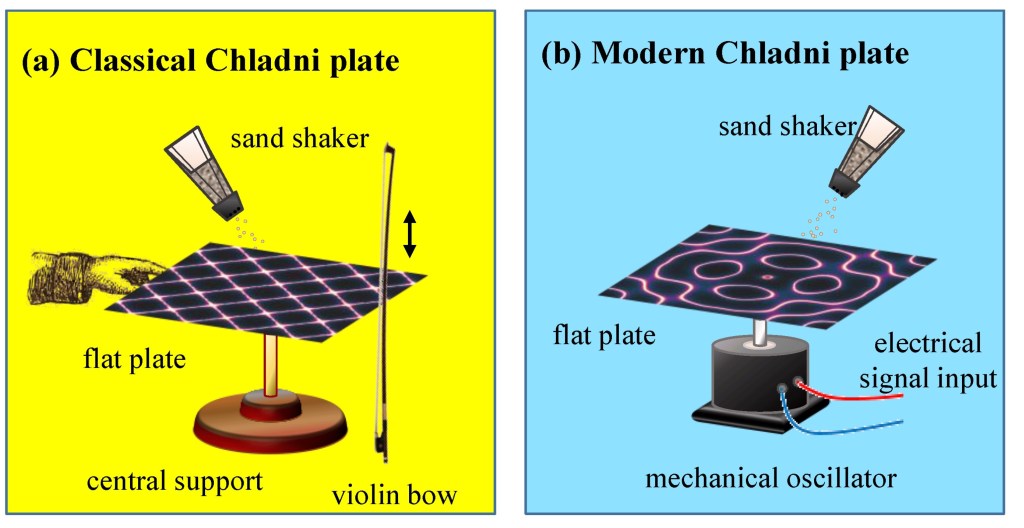
Cymatics (psychophysical) monism holds explanatory power to explain both subjectivity (based on the Music Theory of Consciousness) and shape of a phenomenon (the world we experience).
This is based on phenomenological isomorphism: for each qualia there is a corresponding mathematical object. Let’s have a closer look at formalization.
Since for each and every observer qualia will have slightly different importance (based on the past experience and trajectory within the ruliad), we can describe meaning as a relativistic weight of a certain concept as perceived from a point of view of a certain observer. With this we reached the importance of attention, which will be addressed in more detail in Part 2.
Congruent with the Gestalt theory, each observer inevitably perceives and focuses on a slightly distinct segment of the universe. This is influenced by one’s:
1) position in the ruliad,
2) harmonic/affective signature determining the quality of perception, namely, experienced valence.
Let’s delve into some intriguing connections.

Image source: Taking Monism Seriously
A neuroscientist famous for speaking about his field as being stuck with classical physics, Gyorgy Buzsáki, explainshowthe brain doesn’t have sensors for space and time, all it does is it creates an impression of duration and distance, which are “human-invented terms conveniently classifying events of the world, rather than independent entities.”[5]

An excerpt from Buzsáki (2018)
Implications of Buzsáki’s work move away from the outdated paradigm by carrying relevance for the laws of physics, as well as for the concepts of internal and external time, addressed by both him and Wolfram from an entirely different point of view.
To get a bit back on the topic of entropy and address the title of this whole essay, the key question I’d like to put in the focus (as an additional way of looking at psychedelic thermodynamics and the energy landscape perspective) is precisely the question of whether formalizing qualia with a mathematical framework, such as the ruliad, might provide a model that will manage to explain quantum gravity. Think of psychedelic thermodynamics.
What if all those energy sources and sinks are computational concepts physically implemented and created by us, computationally limited observers, creating a quantum gravitational landscape that quite literally holds our perception of the universe together?
If all the phenomena of classical physics are representations of consciousness on a Markov blanket (a holographic screen[6]), can they say anything about the nature of consciousness rising from the domain? Some connections can be found in cultural anthropology, and that is what cultures have been restlessly doing for thousands of years: sharing stories of most significant events that signify pillars of their culture, such as altered states of consciousness that resulted with somewhat magical, or at least mystical, life-changing events (catharsis, epiphanies) as attributed to saints, mystics, philosophers, or enlightened ones—depending on time and culture how one decides to call them.
Although these stories haven’t yet found a rigorous scientific explanation, I believe that a paradigmatically updated science will find answers in symmetry, in this case, the valence-determining symmetry of the mathematical object isomorphic to a phenomenon.
One of my primary curiosities revolves around the role of black holes in this narrative. What do black holes say about the observer? What kind of conscious representation are they?
In line with previous statements, I’d like point to a possibility of a subjective experience falling into a black hole—not a physical place, but rather a configuration of consciousness without return. If this is true, then we should be familiar with its phenomenology! What could it be?
If we think about all we know about singularity, this is where nondual philosophy and nondual states of mind have to be evoked, as well as the phenomenology of Jungian psychic or ego death phenomena[7]. All of them describe remarkable subjective experiences in which people reportedly undergo fundamental, non-retrievable transformations of the psyche, and/or enlightenment and transcendence, with their verbal interpretation depending on one’s culture. Regardless of one’s skilfulness in linguistic exercise, all the experiences, as described, are phenomenally identical.
To approach this more scientifically and less speculatively, I believe a critical threshold for such experiences remains undetermined. This exploration should reference neural annealing[8], a framework devised to track changes dependent on the measure of energy of consciousness, the Hamiltonian of consciousness[9].
A phase transition in consciousness is warranting an explanation by physics that likely involves a formulation capturing the pivotal evolution of a vibrating string into a loop, a phenomenon already recognized as a central question in quantum gravity research.
In summary, numerous concepts await exploration through the dual-aspect perspective. To avoid crossing the word limit for this essay, I’ll delve into a selection of the most intriguing ones in Part 2 and provide my email address for additional inquiries. I will conclude this section with some reflections on the holographic principle.

Could our pupils be peculiar versions of black holes?
Based on the notable work of independent researcher and physicist Chris Fields (involved in various projects with Karl Friston—the author of Free Energy Principle[10], and Michael Levin—bioelectric fields, cognitive light cones[11], etc.), what we measure and make theories of is only information content on the holographic screen, which can also be interpreted as a Markov blanket.
This is a point I aimed to highlight previously with the distinction between conscious representations and consciousness itself. There is nothing that we can know about the underlying system directly; we are making inferences based on the content available on the screen. Gómez-Emilsson echoed this sentiment in his YouTube video called ‘The screen of consciousness is not fundamental’[12].
Wolfram’s close associate, Jonathan Gorard, wrote a paper “Some Quantum Mechanical Properties of the Wolfram Model” where there is yet another connection, as the paper mentions the potential implications of the Wolfram Model for holography, black hole information, and the AdS/CFT correspondence.
Similar ideas are emerging from various perspectives.
While there are numerous sources to reference, in line with the principle of novelty, I’ll cite the most recent one I encountered, titled ‘All objects and some questions[13]”:
We present an overview of the thermal history of the Universe and the sequence of objects (e.g., protons, planets, and galaxies) that condensed out of the background as the Universe expanded and cooled. We plot (i) the density and temperature of the Universe as a function of time and (ii) the masses and sizes of all objects in the Universe. These comprehensive pedagogical plots draw attention to the triangular regions forbidden by general relativity and quantum uncertainty and help navigate the relationship between gravity and quantum mechanics. How can we interpret their intersection at the smallest possible objects: Planck-mass black holes (“instantons”)? Does their Planck density and Planck temperature make them good candidates for the initial conditions of the Universe? Our plot of all objects also seems to suggest that the Universe is a black hole. We explain how this depends on the unlikely assumption that our Universe is surrounded by zero density Minkowski space.
I interpreted “the screen of consciousness” as a phenomenon akin to the holographic principle and argued that this paves the way for a phenomenological theory of quantum gravity. Given that the gravitational force emerges alongside the hologram and isn’t inherent to the domain[14], I align with Stephen Wolfram’s notion that a unique, computationally bounded observer is a prerequisite for relativity.
Self-similarity and fractality of the holographic universe prompts deeper questions about the functionality of eyes, pupils, and black holes.
[1] Carhart-Harris, R. et. al. 2014. The entropic brain: a theory of conscious states informed by neuroimaging research with psychedelic drugs. https://www.frontiersin.org/articles/10.3389/fnhum.2014.00020/full
[2] Gómez-Emilsson, A. Percy, C. 2023. Don’t forget the boundary problem! How EM field topology can address the overlooked cousin to the binding problem for consciousness. https://www.frontiersin.org/articles/10.3389/fnhum.2023.1233119/full
[3] Youtube. ActInf GuestStream #015.1: Bobby Azarian, Universal Bayesianism: A New Kind of Theory of Everything. https://www.youtube.com/watch?v=_JCaic5Cxms
[4] Tseng, Yu-Chen, Yu-Hsin Hsu, Yu-Hsiang Lai, Yan-Ting Yu, Hsing-Chih Liang, Kai-Feng Huang, and Yung-Fu Chen. (2021) Exploiting Modern Chladni Plates to Analogously Manifest the Point Interaction. Applied Sciences 11, no. 21: 10094. https://doi.org/10.3390/app112110094
[5] Buzsáki, G. Tingley, D. 2018. Space and Time: Hippocampus as a Sequence Generator. https://pubmed.ncbi.nlm.nih.gov/30266146/
[6] Youtube. 2023. Active Inference Institute. Physics as Information Processing ~ Chris Fields ~ Lecture 2. https://www.youtube.com/watch?v=WkWIqpxWRM4
[7] Jung, C. 1953. Archetypes and the Collective Unconscious. Routledge.
[8] Johnson, M. 2019. Neural annealing: toward a neural theory of everything. https://opentheory.net/2019/11/neural-annealing-toward-a-neural-theory-of-everything/
[9] Gómez-Emilsson, A. 2023. Good Vibe Theory. https://qualiacomputing.com/2023/02/25/good-vibe-theory/
[10] Friston, K. 2010. The free-energy principle: a unified brain theory?. Nat Rev Neurosci 11, 127–138. https://doi.org/10.1038/nrn2787
[11] Levin, M. 2019. The Computational Boundary of a “Self”: Developmental Bioelectricity Drives Multicellularity and Scale-Free Cognition. https://www.frontiersin.org/articles/10.3389/fpsyg.2019.02688/
[12] YouTube. 2022. The screen of consciousness is not fundamental. https://www.youtube.com/watch?v=-fTtcOZdsy4
[13] Charles H. Lineweaver, Vihan M. Patel. 2023. All objects and some questions. Am. J. Phys.; 91 (10): 819–825. https://doi.org/10.1119/5.0150209
[14] YouTube. 2023 Andrew Strominger: Black Holes, Quantum Gravity, and Theoretical Physics | Lex Fridman Podcast #359. https://youtu.be/y3cw_9ELpQw
1.2 Problems with neurocentrism
Conceptual difference between consciousness and conscious representations is regrettably largely ignored in academic circles as the majority of researchers share a reductionist neurocentric sentiment. As Lehar pointed out back in 1999, quite ahead of his time, the fundamental limitations of an approach identifying perception to neural network models were noticed even earlier by Gestalt theory showing that local features cannot be reliably identified in the absence of global context. [1]
Research and insights from thinkers like Michael Levin, Anna Ciaunica, Karl Pribram, Susan Pocket, Chris Fields, and Karl Friston suggest that consciousness shouldn’t be sought solely in the brain. Instead, consciousness resides in the self-organizing system encompassing the entire body. Electromagnetic field behaviour has not only been contemplated by them, but also by many other scientists and philosophers such as Alfred North Whitehead, Rupert Sheldrake, David Bohm, Susan Pockett, and more recently Andrés Gómez-Emilsson. As this topic is a rabbit-hole, I will include some relevant resources in the bibliography.
The point that the amazing paper ‘The brain is not mental’ by Levin and Ciaunica wants to convey to the reader is that immune cellular processing is a key factor in complementing neuronal processing in achieving successful self-organization and adaptation of the human body in an ever-changing environment. More precisely, cognition is seen as a multiscale web of dynamic information processing distributed across a vast array of complex cellular systems operating across the entire body, and not just the brain. Therefore, cognition can minimally be defined as information processing within a self-organizing system. I believe that enteric nervous system (nicknamed as ‘the second brain’) governing the function of the gastrointestinal tract and acting independently on the sympathetic and parasympathetic nervous systems would not object having more attention.
Either from Lehar’s Harmonic Resonance, or the neuroacoustics perspective as described by Johnson[2], the brain functions as a set of connected acoustic chambers in which significant signals are not carried by the individual action potentials, but rather by the frequency of their occurrence. We can think of it as a multi-part building, with each room tuned to make slightly different harmonies resonate, with doors opening and closing all the time. Johnson concludes:
The harmonies are thoughts; the ‘rooms’ are brain regions.
Importantly, the transformations which brain regions apply to thoughts are akin to the transformations a specific room would apply to a certain harmony, just like the shape of an instrument determines how it will sound. The acoustics of the room— i.e., the ‘resonant properties’ of a brain region–profoundly influence the pattern occupying it. This idea goes hand in hand with the previously mentioned neuroscience paper by Fornito and Pang which emphasizes the importance of the shape of the brain.
So, why music? Johnson’s basic argument is that you can explain basically every important neural dynamic within the brain in terms of resonance, that it’s a comprehensive, generative, and predictive model – much more so than current ‘circuit’ or ‘voting’ based analogies. My basic argument is that music keeps on being used as a problem-solving lens across multiple disciplines, it teaches us about harmony and symmetry, and somehow it keeps on working.
1.3 Finding evidence in math
According to this ontological perspective, all phenomena are in essence nondual (dual aspect monism) in the domain. Could a simple translation rule be applied in order to open up a way for demystifying the fine-structure constant? Could it be a result of translation between the fundamental, nondual state, and the space-time, holographic, screen-of-consciousness-representations?
This mathematical thought experiment might be incorrect, but nevertheless, I believe dual aspect theory will offer new, radical ways of interpreting laws of physics and the natural constants. No laws need to bee changed, only our perspective.
One other formula that seems to carry significance in the dual aspect theory (the observed is the observer) is Euler’s Identity, which highlights the profound connections between various mathematical concepts, including real and imaginary numbers, exponentials, and trigonometric functions.
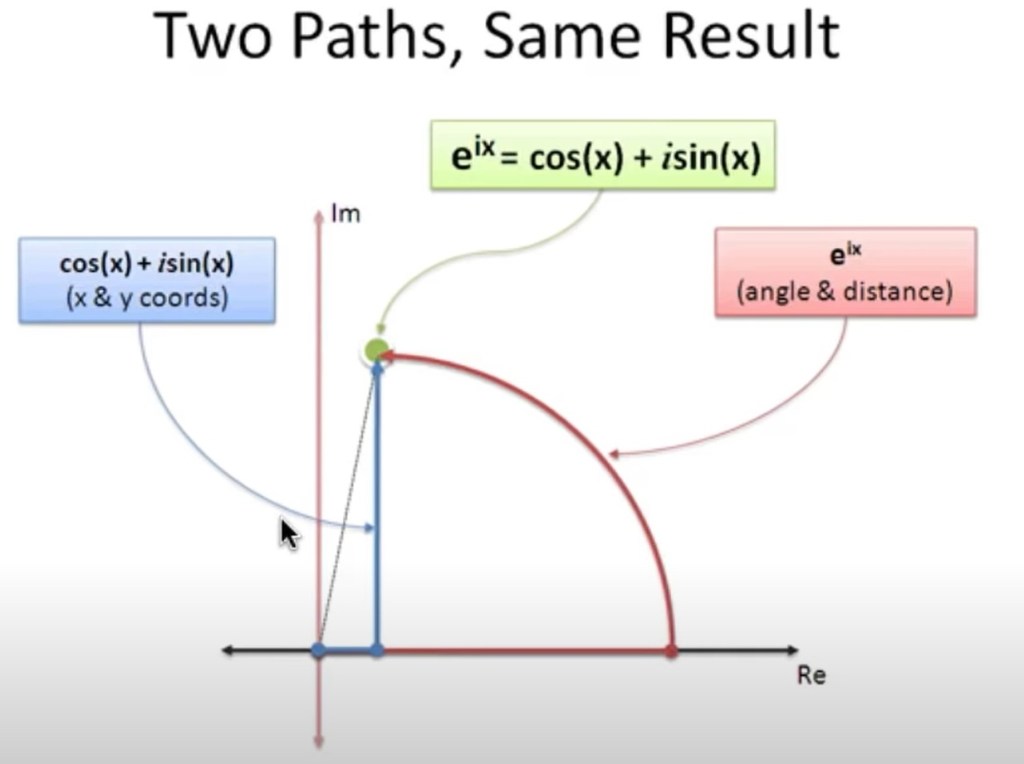
Image 1: Two paths, same result. Source: YouTube
Given all that we now know, could we consider assigning physical meaning (application) to the famous Identity, in Richard Feynman’s words—our jewel and the most remarkable formula in mathematics—and think of it as an equation revealing a deeper truth about a balance upon which our reality stands? There would be more to say about this and Zero Ontology.
I wrote more about this in a post[3] published in March and here is an excerpt from the Appendix:
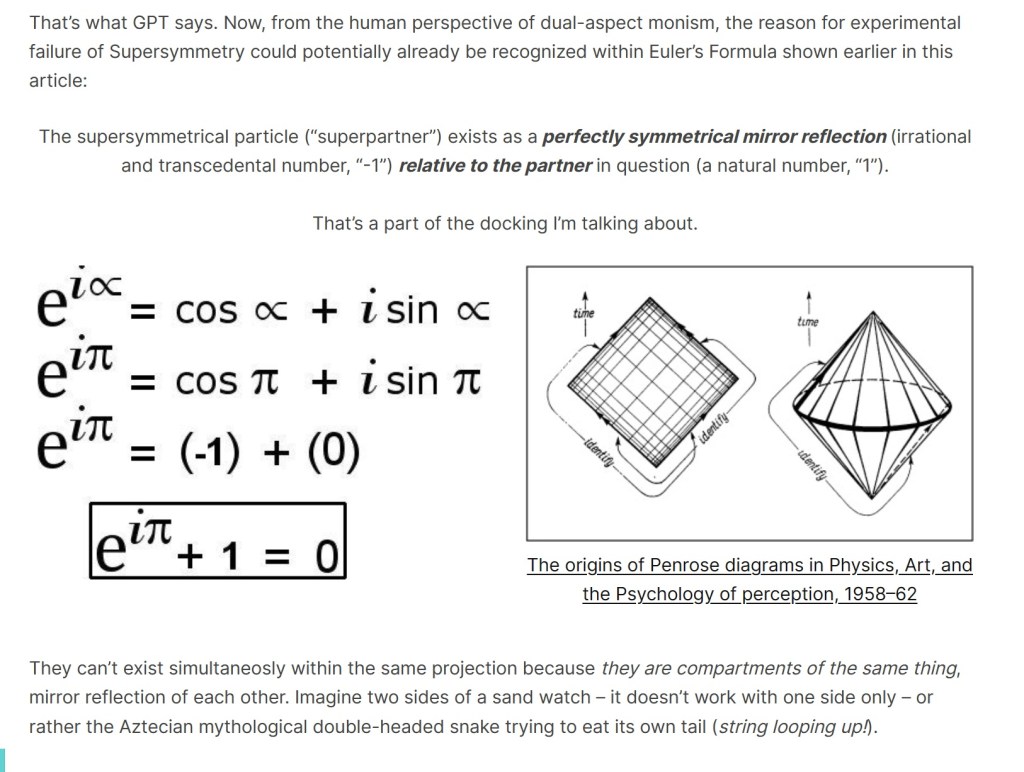
Image 2: Screenshot sourced from the blog
www.thingsiwasntsupposedtotalkabout.com
[1] Lehar, S. 1999. Harmonic Resonance Theory: An Alternative to the “Neuron Doctrine” Paradigm of Neurocomputation to Address Gestalt properties of perception. http://slehar.com/wwwRel/webstuff/hr1/hr1.html
[2] Johnson, M. 2017. Taking Brain Waves Seriously. https://opentheory.net/2017/06/taking-brain-waves-seriously-neuroacoustics/
[3] Thoughts on Evolutions. 2023. Phenomenology of “Psychic Death” as Molecular and Geometric Docking, Euler’s Identity, Qualia & Gravitation Through the Lens of Cymatics Monism. https://thingsiwasntsupposedtotalkabout.com/2023/03/28/9-phenomenology-of-psychic-death-as-molecural-and-geometric-docking/
Part 2: List of further topics and predictions
Here is an overview of 15 topics and predictions I’ve chosen as relevant for this discussion.
1) The phenomenology of individual experiences addressed through field topology. The topological boundary problem received its solution by Gómez-Emilsson and Chris Percy, as published this year in Frontiers[1].
“Why can’t one consciousness ‘get inside’ another?”, Wolfram delves into the question in ‘The Concept of the Ruliad’. I’d like to emphasise the importance of unique combinations of past trajectory, and memories not only of past experiences, but also of dreams, all the ideas and imagination that inevitably add something additional to our experience. Interesting resource to add is a neuroscience paper[2] published in Nature in May 2023 discussing subjective signal strength determining reality from imagination. This leads to further assumptions on the nature of phenomena such as delusions or hallucinations. What will consciousness say about schizophrenia?
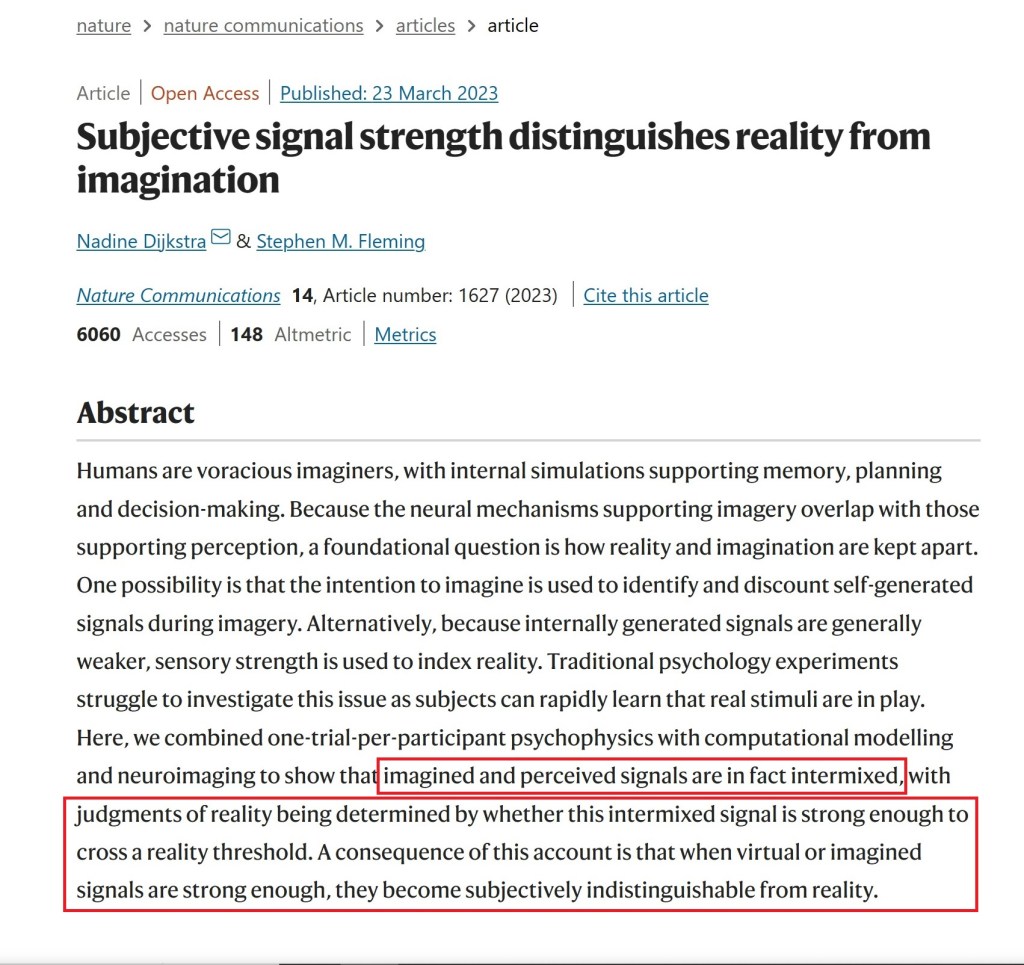
Source: www.nature.com
2) Cymatics monism as a more precise expression of dual aspect monism provides us with two necessary properties; sound and shape.
Recent work in neuroscience (such as aforementioned Geometric constraints on human brain function[3] published in April) connects this ontological assumption to a more real and measurable parameter which is geometry of the brain and the curious behaviour of cerebrospinal fluid and its amplitudes in exotic states of consciousness.
Neuroacoustics is a new framework and as such it hasn’t yet been explored in academic circles as a highly probable factor in studying brain dynamics. Even though Connectome Harmonics[4] by Selen Atasoy was one of the leading frameworks responsible for development of neural annealing, it lacks the geometry component. This leads us to Point 3.
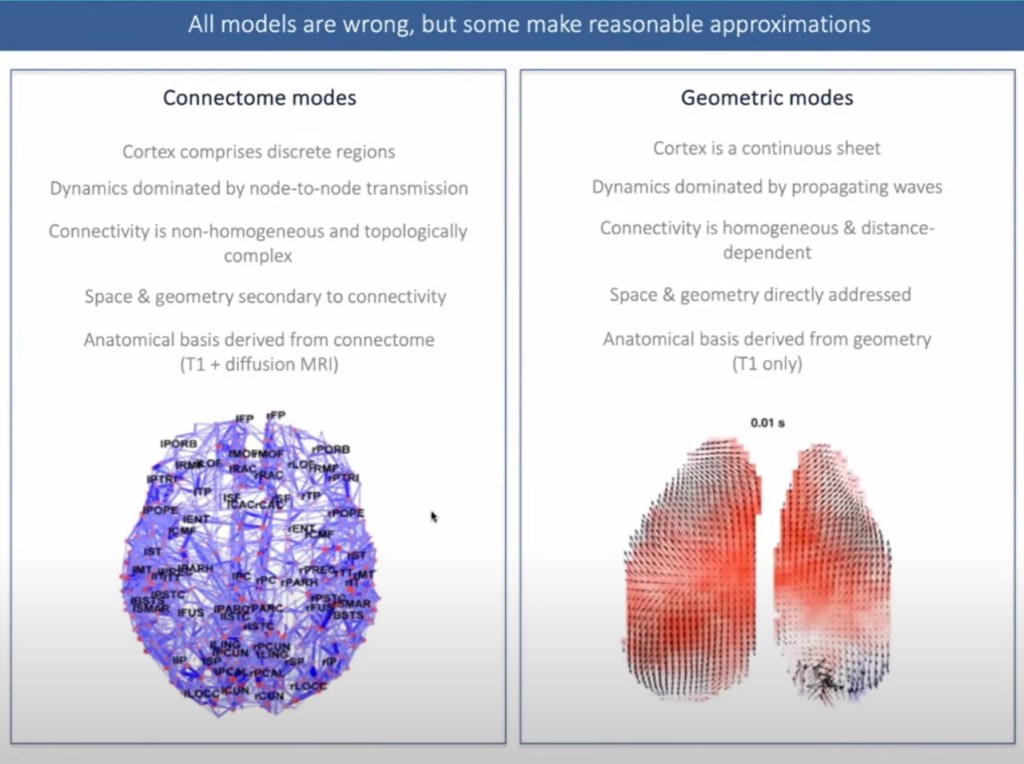
Screenshot from Active Inference Institute 2023 presentation on ‘Geometric constraints on human brain function’ by Alex Fornito and James Pang.
3) Wavefunction realism.
The question of why anything moves at all can be approached from the perspective of vibrating energy at the fundamental level. Furthermore, building upon the point presented in Point 2, hyperdimensional vibrating strings come with a corresponding shape. According to the holographic principle and Pribram’s holonomic brain, this vibrating structure is implemented on the frequency domain from which the hologram emerges together with gravitation. Further investigation needs to take into account work by Hawking, Strominger, Susskind, Pribram, etc., as well as the deeper implications of superimposed standing waves created by the superposition of two identical waves moving in opposite directions, which takes us to Point 7.
4) Nondual states of consciousness are important exotic phenomenal events.
I believe such phase transition resulting with a loop on a fundamental level has historically been called “spiritual enlightenment”, a necessary experience of the laws of physics perceived by a computationally bounded observer like us. Take into account I wrote experience, rather than the narrative about it. This tendency of organisms towards blissful and pleasurable states of consciousness might explain the loopy tendency of strings in loop quantum gravity, as described by Carlo Rovelli in a conversation[5] with Sean Carroll. Broken symmetry isn’t sustainable.

Nervous system trained in equanimity directed toward unpleasant sensations demonstrates “superhuman” abilities presumably due to its symmetrical configuration which is, as laws of symmetry dictate, resistant to any change.
5) Neural annealing.
We can demonstrate how and why the phenomenology of love and peace is important for thermodynamic reasons due to a consonant energy flow. Gómez-Emilsson points out there are nervous systems (such as those of the Buddhist 4th path attainers) purified in such a way that they might as well be described as superconductors. There’s relevance in this also for Point 4.
QRI research inspired by the work of Selen Atasoy on Connectome Harmonics.
Consonant resonant mode can be achieved by annealing: resonances of our world-simulations start to click with each other, they are “in phase”.
6) Research on psychedelic and exotic states of consciousness, like N,N-DMT, indicates that during a breakthrough trip, as entropic disintegration peaks, individuals often feel disconnected from conventional notions of space and time, akin to the content of a holographic screen.
What is it that is left if the screen is gone? “DMTx” is the name of one ongoing project at Imperial College London that wants to have a deeper look at this phenomenology. Both Andrew Gallimore and Graham Hancock were moderators of the first public discussion with the participants.

Illustration from qualiacomputing.com.
“Near-death experiences (NDEs) are complex subjective experiences, which have been previously associated with the psychedelic experience and more specifically with the experience induced by the potent serotonergic, N,N-Dimethyltryptamine (DMT)”. — Frontiers
7) The ontological necessity of pairs and dual aspect monism tell us important things about empirical failure of detecting superpartners and supersymmetry.
Euler’s identity might take us further on this matter. (Relating to “1.3 Finding evidence in math”)
People have been looking for supersymmetry since the ‘80s and it still hasn’t worked, right?
Sabine Hossenfelder
In brief, the two opposites (1/0, A/B, ON/OFF) as perceived by us are a necessary feature of binary computation. On a fundamental level, classically perceived opposites are the very same qubit, but the observer like us perceives them as separated. Because superpartners are fundamentally unified, dual aspect monism, with its essence captured in Euler’s formula, I claim, might be the reason why a superpartner can’t be detected with our current methodology.
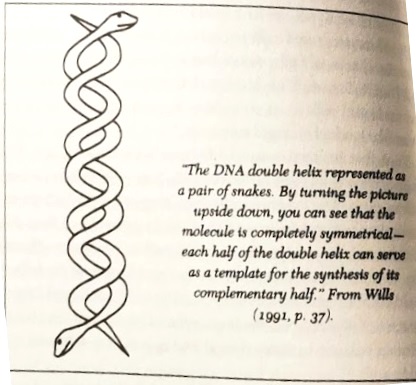
Source: Jeremy Narby, The Cosmic Serpent
Once unified, complementary shapes dock and lock by functionally becoming one entity, a physical process we perceive as annihilation, which according to the formula, results in 0. This idea takes us back to point 4.
7.1) The longest nerve in the body, like a string to pluck, also comes in pairs. One vagus nerve for the right side, and one for the left. It’s often described as responsible for the mind-body connection. Ventral pathway takes part in meaning, while dorsal in representation:
What is it vs. How to manipulate it
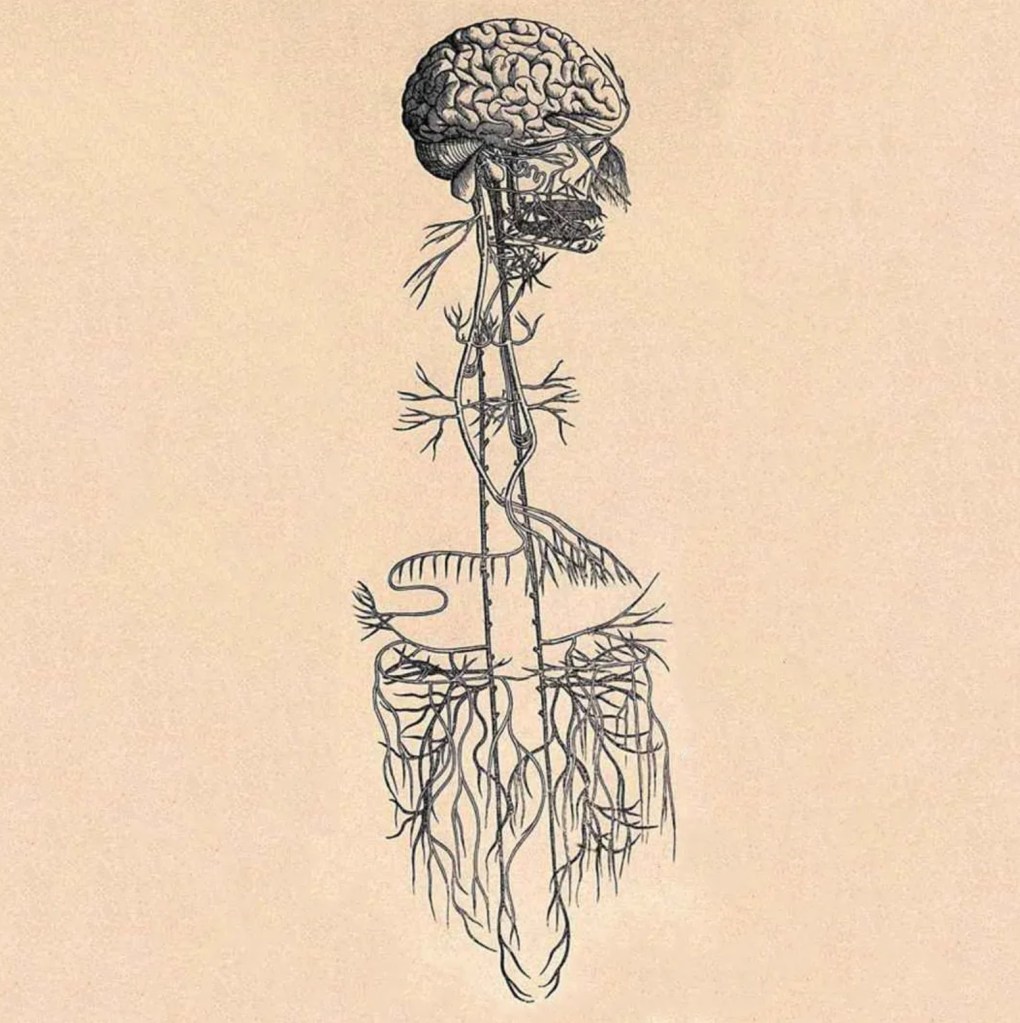
After 10 years of study and research, psychiatrist Iain McGilchrist published book on the issue of the two hemispheres. By many critics, this is the most important work on cognitive science and philosophy of mind of 21st century so far.
8) Music Theory of Consciousness.
The Pythagoreans developed the concept of the music of the spheres, which posited that celestial bodies, like planets and stars, emitted harmonious sounds as they moved through space. But what does this say about the observer making the conclusion?
I suggest that distance and duration, as dimensions that modern science have chosen to represent the concepts of space and time, are perceived by us as they are because of the principles of harmony and symmetry. This idea leads us to the tuning system of 12-tone equal temperament as a potential for explain patterns we observe.
Pythagoreans weren’t the only ones.
I believe in Spinoza’s God who reveals himself in the orderly harmony of what exists, not in a God who concerns himself with fates and actions of human beings.
Albert Einstein
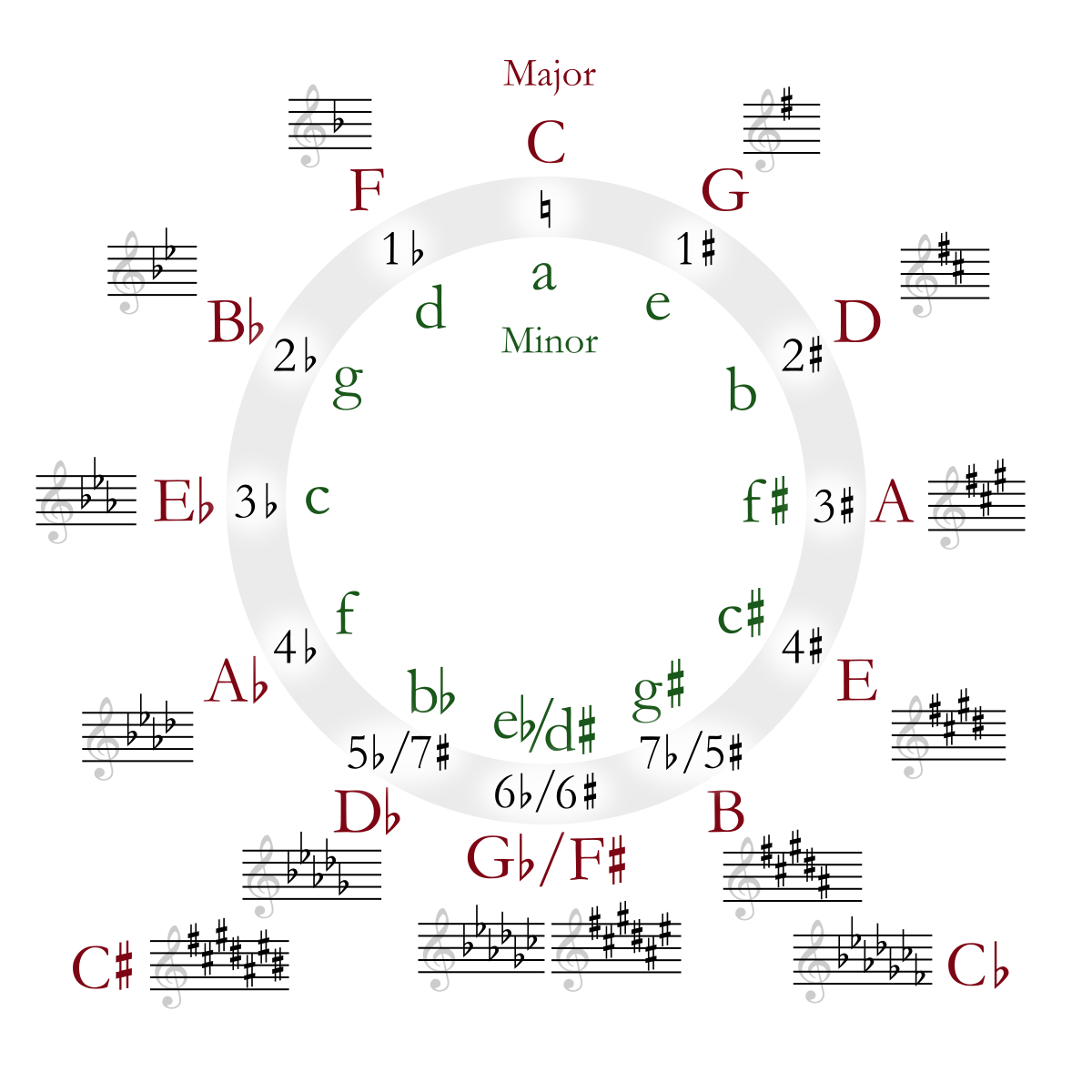
The circle of fifths. What sounds good depends on what was previously played and on what already plays in the background.
Why this particular rule and not another? For the beginning, it’s the one that tells us what feels good.
While working with Karl Pribram, zoologist Karl Spencer Lashley (the one responsible for inspiring Chomsky’s generative grammar), reached a conclusion after 30 years of research on memory in primate brains:
Engram doesn’t exist in the cortex. No matter how much of a rat’s cerebral cortex was removed, the rat continued to remember its route through a maze.
As Pribram independently noted, search for memory in the brain revealed that it wasn’t individual neurons that are responsible for a memory trace, rather it was the pattern that counted. Like pressing keys on a piano determining a chord, only this system was unimaginably larger, as it probably entailed 86 billion neurons. In the book Electromagnetic Theories on the Nature of Consciousness[6], a conclusion of Pribram’s and Lashley’s collaborative work is given:
All behaviour seems to be determined by masses of excitation, by the form or relations or proportions of excitation within general fields of activity, without regard to particular nerve cells.
Could Music Theory of Consciousness, together with Qualia Formalism and the Symmetry Theory of Valence, be the only reasonable universal lens providing a sensible empirical framework for measuring valence? I mean, even Dennett finds the workings of music intriguing and mysterious.[7]
9) Fine-structure constant as a translation rule between fundamental energy in the domain and the object (Plato’s forms or shapes) projected in the hologram.
In dual aspect monism, there should be a bridge between the two.
10) How does the neural annealing framework, influenced by the energy of consciousness (or the Hamiltonian of consciousness), align so closely with the analogy of metal? How does this correlate with the holographic principle?
In a recent science research session on the matters of hyporuliad[8], Wolfram asked Gorard what is a photon in the branchial space. They agreed they don’t have the answer.
Could gravitations and gravitons represent internal, dual aspect analogues to photons? This speculation continues in Point 11. If we are indeed constrained by the harmonics played by our connectome, maybe it’s the graviton riding the slide and choosing branches that are available.
Attention –> Curvature –> Gravitation
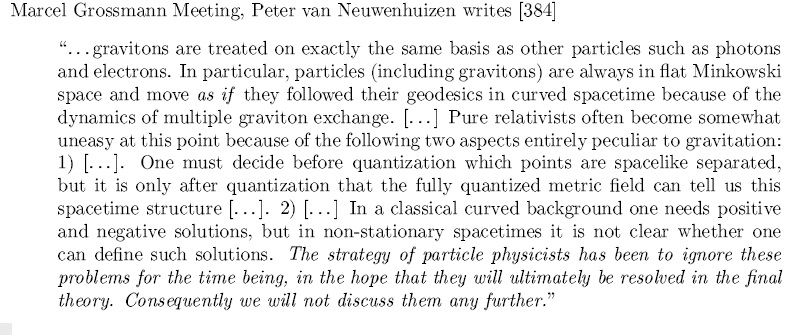
Excerpt from the Carlo Rovelli’s monograph Quantum Gravity
11) Exotic states of consciousness in their phenomenology reveal incredibly important causal significance of attention (wave modulation) for determining what will be observed and how.
In my last year’s essay Gravitation as the Natural Language of Attention I touched upon the significance of attention across various contexts:
1) in attributing subjective, relative weight to the concepts and events (as in the ruliad)
2) in forming and manipulating attractors in energy landscape (sinks and sources) of an individual observer
3) for qualia and phenomenal resonance of the internal representations
Wolfram’s talk ‘How Features of Our Consciousness Seem to Define Our Laws of Physics and Maths’ is of relevance here.
Interesting implication crossing my mind is the opening of a new, paradigmatically updated branch of (computational) psychiatry that would study personality and other psychiatric disturbances as disorders of attention through psychedelic thermodynamics, energy sources and sinks, and, potentially, a dual aspect theory of quantum gravity.
12) Heisenberg Uncertainty Principle as a result of the branching brain observing the branching universe, i.e. the observer observing itself — the observed (atman and brahman).
13) The Symmetry Theory of Valence.
If a subjective experience can be represented as some kind of a mathematical object, then the symmetry of that object corresponds to how pleasant the experience is. In other words, a formal hypothesis that harmony in the brain feels good, and dissonance feels bad. Leading to Point 8.
If consciousness is real in the same way as electrons are real, symmetry considerations will dominate the ontological structure of consciousness in the same way they do in physics.
Michael Johnson
14) AI will not be conscious until conscious representations produced by the brain continue being mistaken for consciousness.
What the brain is responsible for are conscious representations and those may have neural correlates attempted to be mapped out by current methodology in neuroscience, but the whole organism takes part in cognition by determining the quality of subjective experience given by consonance and smoothness of the propagation of energy waves, a process ultimately leading to effectiveness of global information propagation, i.e. conductivity and transmission of bioelectric signals.
This is the energetic process underlying neural annealing—QRI’s unified theory of music, meditation, psychedelics, depression, trauma, and emotional processing.
The insentience of classical Turing machines isn’t incidental. It’s architecturally hardwired. A substrate of carbon or silicon makes no difference to their zombie status. Decoherence makes implementations of classical Turing machines physically possible AND prevents digital computers from supporting phenomenally-bound subjects of experience, i.e. minds and the world-simulations we run. Digital mind is an oxymoron.
David Pearce on Twitter[9]
15) Just as biology seeks food, consciousness seeks harmony.
Ancient Greeks believed that love belongs to the higher realm of transcendental concepts that mortals can barely conceive of in their purity, catching only glimpses of the Forms’ conceptual shadows that logic and reason unveil or disclose. [10] They knew how to anneal well, but were they right?
And remember, the screen is not fundamental!
[1] Gómez-Emilsson, A., Percy. 2023. Don’t forget the boundary problem! How EM field topology can address the overlooked cousin to the binding problem for consciousness. Front. Hum. Neurosci. 17:1233119. doi: 10.3389/fnhum.2023.1233119
[2] Dijkstra, N., Fleming, S.M. 2023. Subjective signal strength distinguishes reality from imagination. Nat Commun 14, 1627. https://doi.org/10.1038/s41467-023-37322-1
[3] Fornito, A. Pang J. 2023. Geometric constraints on human brain function. https://www.nature.com/articles/s41586-023-06098-1
[4] Atasoy, S. 2016. Human brain networks function in connectome-specific harmonic waves. https://www.nature.com/articles/ncomms10340
[5] Carroll, S. 2018. Mindscape Podcast. https://www.youtube.com/watch?v=3ZoeZ4Ozhb8
[6] Renée Joye, S. 2018. The electromagnetic brain: EM field theories on the nature of consciousness. Rochester, Vermont: Inner Traditions
[7] Dennett. D. 2006. Breaking the Spell: Religion as a Natural Phenomenon. London: Penguin Books
[8] YouTube. 2023. Science Research Session: Hyporuliad. https://www.youtube.com/watch?v=lZaBjuHk7Ms
[9] Twitter.
[10] Internet Encyclopaedia of Philosophy. https://iep.utm.edu/
Part 3: Conclusion
This essay represents a concerted effort not only to synthesize important concepts presently under consideration at the frontiers of consciousness research, but also to discern their shared attributes and potential ramifications for the advancement of scientific knowledge. Thinkers and researchers who are aware of the issues presented concur on the shared responsibility for responding to the outdated reductionist paradigm that doesn’t acknowledge the reality and causal power of minds.
I don’t assert infallibility of any of the assumptions and implications posited in the essay. However, I do believe in their potential to instigate deeper contemplation that could ultimately yield improved explanations. As there is a lot more to unpack, and a word limit for an essay, I hope that the reader will nonetheless manage to derive a conceptual understanding of the language of qualia and the framework supported by a compendium of resources provided in the bibliography.
Speaking of the language of qualia, on the QRI’s website[1] one can find both a qualia glossary and a brief introduction summarizing the institute’s focus:
“Founded in 2018, our focus lies in developing a mathematical framework for subjective experience and understanding emotional valence. Our rigorous research and theoretical insights are directed towards mapping the state-space of conscious experience. We maintain a collaborative community of researchers and thinkers, all dedicated to creating technologies that improve the well-being of sentient beings.”
What Wolfram Research brings to the search for an observer theory is the ruliad as the computational and mathematical framework, whilst the intention of this essay was to introduce the other part, a blueprint for the science of valence and subjective experience, resting upon symmetry and harmony, and lacking a rigorous mathematical formalization. Merging these two approaches could produce remarkable results. Specifically, testing the veracity of Qualia Formalism and Structuralism as theoretical premises with empirical adequacy could, to say the least, represent a significant advancement in formalizing the science of consciousness.
I’d like to thank Qualia Research Institute and Sweet Baby Angels for their support.
References
Atasoy, S., Donnelly, I. & Pearson, J. (2016) Human brain networks function in connectome-specific harmonic waves. Nat Commun 7, 10340 https://doi.org/10.1038/ncomms10340
Azarian, B. (2022) The romance of reality. Dallas: BenBella Books.
Buzsáki G and Tingley D. (2022) Space and Time: The Hippocampus as a Sequence Generator. Trends Cogn Sci. 2018 Oct;22(10):853-869. doi: 10.1016/j.tics.2018.07.006. PMID: 30266146; PMCID: PMC6166479.
Carroll, S. (2019) Something Deeply Hidden: Quantum Worlds and the Emergence of Spacetime. London: Oneworld.
Ciaunica A, Shmeleva EV and Levin M. (2023) The brain is not mental! coupling neuronal and immune cellular processing in human organisms. Front. Integr. Neurosci. 17:1057622. doi: 10.3389/fnint.2023.1057622
Carhart-Harris RL, Leech R, Hellyer PJ, Shanahan M, Feilding A, Tagliazucchi E, Chialvo DR and Nutt D (2014) The entropic brain: a theory of conscious states informed by neuroimaging research with psychedelic drugs. Front. Hum. Neurosci. 8:20. doi: 10.3389/fnhum.2014.00020 Fornito A., Pang. Geometric constraints on human brain function.
Dennett. D. (2006) Breaking the Spell: Religion as a Natural Phenomenon. London: Penguin Books
Dijkstra, N., Fleming, S.M. (2023) Subjective signal strength distinguishes reality from imagination. Nat Commun 14, 1627. https://doi.org/10.1038/s41467-023-37322-1
Friston, K. (2010) The free-energy principle: a unified brain theory?. Nat Rev Neurosci 11, 127–138. https://doi.org/10.1038/nrn2787
Goff, P. (2019) Galileo’s Error. London: Rider Books
Gómez-Emilsson, A. (2023) Good Vibe Theory. Qualia Computing. https://qualiacomputing.com/2023/02/25/good-vibe-theory/
Gómez-Emilsson, A. (2021) Healing trauma with neural annealing. https://qri.org/blog/neural-annealing
Gómez-Emilsson, A. Percy, C. (2023) Don’t forget the boundary problem! How EM field topology can address the overlooked cousin to the binding problem for consciousness.. https://www.frontiersin.org/articles/10.3389/fnhum.2023.1233119/full
Helmholtz, H. (1954) On the sensations of tone as a physiological basis for the theory of music. New York: Dover Publications
Hossenfelder, S., Smolin L. (2009) Phenomenological Quantum Gravity. https://arxiv.org/abs/0911.2761
Internet Encyclopaedia of Philosophy. https://iep.utm.edu/
Johnson, M. (2017) Taking brain waves seriously: Neuroacoustics. https://opentheory.net/2017/06/taking-brain-waves-seriously-neuroacoustics/
Johnson, M. (2009) Toward a new ontology of brain dynamics: neural resonance + neuroacoustics. https://opentheory.net/2009/11/toward-a-new-ontology-of-brain-dynamics-neural-resonance-neuroacoustics/
Johnson, M. (2019) Neural annealing: toward a neural theory of everything. https://opentheory.net/2019/11/neural-annealing-toward-a-neural-theory-of-everything/
Johnson, M. (2017) Principia Qualia. https://opentheory.net/PrincipiaQualia.pdf
Jung, C. (1953) Archetypes and the Collective Unconscious. Routledge
Gorard, J. (2020) Some Quantum Mechanical Properties of the Wolfram Model. https://www.wolframcloud.com/obj/wolframphysics/Documents/some-quantum-mechanical-properties-of-the-wolfram-model.pdf
Lehar, S. (1999) Harmonic Resonance Theory: An Alternative to the “Neuron Doctrine” Paradigm of Neurocomputation to Address Gestalt properties of perception. http://slehar.com/wwwRel/webstuff/hr1/hr1.html
Levin M. (2019) The Computational Boundary of a “Self”: Developmental Bioelectricity Drives Multicellularity and Scale-Free Cognition. Front. Psychol. 10:2688. doi: 10.3389/fpsyg.2019.02688
Narby, J. (1999) The cosmic serpent: DNA and the origins of knowledge. Penguin Publishing Group
Pearce, D. (2014) Non-materialist physicalism: an experimentally testable conjecture. www.physicalism.com
Qualia Research Institute. www.qri.org
Renée Joye, S. (2018) The electromagnetic brain: EM field theories on the nature of consciousness. Rochester, Vermont: Inner Traditions
Rovelli, C. (2007) Quantum gravity. Cambridge University Press
Sulzer, D. (2021) Music, math, and mind. New York: Columbia University Press
Twitter. https://x.com/webmasterdave/status/1680002648794099712?s=20
Wikipedia. Unresolved problems in physics. https://en.wikipedia.org/wiki/List_of_unsolved_problems_in_physics
Wolfram, S. (2021) The Concept of the Ruliad. https://writings.stephenwolfram.com/2021/11/the-concept-of-the-ruliad/
Wolfram, S. (2021) What Is Consciousness? Some New Perspectives from Our Physics Project. https://writings.stephenwolfram.com/2021/03/what-is-consciousness-some-new-perspectives-from-our-physics-project/
YouTube. (2023) Andrew Strominger: Black Holes, Quantum Gravity, and Theoretical Physics | Lex Fridman Podcast #359. https://youtu.be/y3cw_9ELpQw
YouTube. (2023) Science Research Session: Hyporuliad. https://www.youtube.com/watch?v=lZaBjuHk7Ms
 Thoughts On Evolutions
Leave a comment